Why Choosing Arts in 2026 Is a Strategic Decision?
Here is a question that thousands of Class 10 students across India are sitting with right now: “Should I take Arts after 10th, or will that ruin my future?” The honest answer is that this question is based on a myth that has survived way longer than it should have.
The Arts stream is not a consolation prize. It is not the stream you pick when you cannot get into Science or Commerce. In 2026, it is a deliberate, strategic choice that opens doors to Law, Psychology, Design, Civil Services, Journalism, and Management, fields that are growing faster than many STEM sectors in India.
India’s creative and cultural industries, what economists now call the “Orange Economy”, are projected to generate 10 million jobs by 2026, according to reports cited by UNESCO and the CII. These are not low-skill jobs. They include UX designers at tech companies, corporate lawyers negotiating billion-rupee deals, and IAS officers shaping national policy.
The real question is not whether Arts is a good choice. The real question is which Arts career path is the right fit for you. If you are still figuring out whether to even go to Class 11 or pursue a diploma instead, this guide covers that, too. Read on.
Already know you want Arts but unsure where it leads? Check out this detailed breakdown of what to do after 10th if you do not want Science or Commerce for a broader perspective before you decide.
Here, we will discuss the Best Career Options in Arts Stream after 10th
Table of Contents
- Arts vs. Science vs. Commerce: The Honest Comparison
- Class 11 Arts vs. Diploma or Polytechnic After 10th: Which Path Is Right for You?
- Best Career Options in Arts Stream After 10th: A Deep Dive
- Job-Oriented Short Courses Arts Students Can Stack
- Salary Reality Check: What Arts Careers Actually Pay
- Five Questions to Ask Before Choosing Arts in Class 11
- FAQs about the best career options in Arts Stream after 10th
- Final Word: Make the Choice for Something, Not Away from Something
Arts vs. Science vs. Commerce: The Honest Comparison
Before you finalise your stream, you deserve a straight comparison, not the version filtered through your relatives’ opinions.
Science gives you a higher floor. Engineering and medicine are safe fallbacks with predictable career paths. Commerce gives you a structured path to business, such as CA, MBA, or finance roles. Arts gives you something different: it gives you the highest ceiling in certain fields, and the widest range of options across all three streams.
Here is what the comparison actually looks like:
| Factor | Science | Commerce | Arts |
| Career Flexibility | Low-Medium | Medium | High |
| Top Salary Ceiling | ₹25–60 LPA (Tech/Medical) | ₹20–50 LPA (CA/MBA) | ₹30–60 LPA (Law/Design/IAS) |
| Entry Difficulty | High (JEE/NEET) | Medium (CA/CMA) | Medium (CLAT/NID/UPSC) |
| AI-Proof Skills | Partially | Partially | Strongly |
| Board Marks Dependency | Very High | High | Low-Medium |
| Best For | Engineering, Medicine | Finance, Accounting | Law, Design, Civil Services, Psychology |
The most important insight here: Arts careers depend far less on board exam marks than Science or Commerce. A student who scores 75% in Class 12 Arts can still crack CLAT, NID entrance, or UPSC. These exams test aptitude, reasoning, and knowledge, not rote marks.
If you want to understand how much board marks actually matter for your career, this article on how board exam marks affect your career will give you a reality check worth reading.
A note on the parent conversation: If your family is pushing back on Arts, the strongest argument you can make is not emotional. It is financial. Point to the salary table in Section VI of this article. Lawyers, IAS officers, and senior designers regularly out-earn engineers at the mid-career stage.
Class 11 Arts vs. Diploma or Polytechnic After 10th: Which Path Is Right for You?
Not every student reading this has already decided to go to Class 11. Some of you are weighing a completely different route: a diploma or polytechnic program that lets you skip 11th and 12th entirely and enter the workforce faster. This section gives you an honest comparison.
What Diploma and Polytechnic Programs Actually Offer
Diploma and polytechnic courses are typically 2 to 3 years long and are available after Class 10. They are offered by government and private polytechnic institutes across India and cover fields like Electrical Engineering, Civil Engineering, IT, and Mechanical. The biggest advantages are lower cost, faster completion, and direct entry into technical jobs.
For a detailed look at the best options available right now, the guide on diploma courses after 10th covers fees, duration, and salary expectations comprehensively.
The Honest Comparison Table
| Factor | Diploma/Polytechnic | Class 11 Arts |
| Time to First Income | 2–3 years | 5–7 years |
| Typical Salary Ceiling | ₹4–10 LPA (most roles) | ₹15–40+ LPA (Law, Design, UPSC) |
| Career Flexibility | Low–Medium | High |
| Cost of Education | Lower | Medium–High (for degree) |
| 10+2 Required? | No | Yes (prerequisite for most degrees) |
| Best For | Immediate employment, vocational goal | Long-term career building in Law, UPSC, and Design |
Who Should Choose Diploma/Polytechnic
- You have a clear vocational goal, such as electrical work, civil drafting, or IT support.
- Your family has financial constraints, and you need to start earning sooner.
- You are certain you do not want to pursue Law, UPSC, Design degrees, or Mass Communication, all of which require 10+2 as a hard prerequisite.
Who Should Choose Class 11 Arts
- You are targeting Law (CLAT/AILET), Civil Services (UPSC), Design (NID/NIFT), or Journalism.
- You want career flexibility: the ability to pivot between multiple high-paying fields.
- You are interested in the human side of things: politics, society, psychology, communication, or creative work.
Still weighing whether a degree or diploma is the better long-term investment? This comparison of degree vs. diploma in India 2026 breaks down the ROI in detail.
Best Career Options in Arts Stream After 10th: A Deep Dive
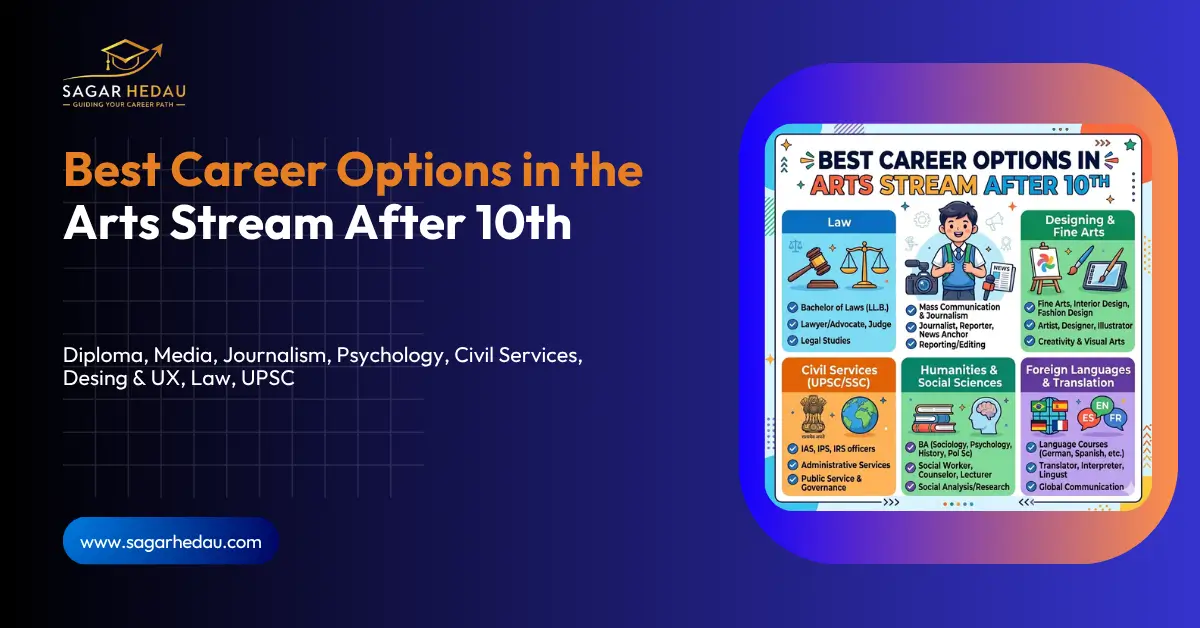
Below are the five most high-potential career paths for Arts students in 2026, each with a realistic roadmap, entrance exam guidance, and salary data by experience level.
1. Law: The 5-Year Integrated Route
Law is arguably the single highest-return career you can build from the Arts stream in India. The entry point is the 5-year integrated BA LLB or BBA LLB program, which you can get into right after Class 12 through CLAT (Common Law Admission Test) or AILET (All India Law Entrance Test).
The smart students start CLAT preparation in Class 11 itself. The exam tests English comprehension, current affairs, logical reasoning, and legal aptitude, all of which are naturally strengthened by an Arts curriculum.
Two distinct tracks exist after your LLB:
- Corporate Law: Joining a top-tier law firm (Tier-1 firms like AZB, Cyril Amarchand, Khaitan & Co) as an associate. High pressure, high pay, fast growth.
- Judiciary/Civil Services: Appearing for State Judicial Service exams or the Higher Judicial Service. More stable, socially respected, and excellent perks.
Salary reality: Entry-level at a Tier-1 law firm is ₹7 to ₹9 LPA. At 5 to 7 years of experience, corporate lawyers earn ₹20 to ₹35 LPA. Senior partners at top firms cross ₹50 LPA. Judges in the higher judiciary receive comparable government-scale pay with significant non-monetary benefits.
Law is also one of the most AI-proof careers in India. Legal strategy, courtroom advocacy, and client trust cannot be automated.
2. Design and UI/UX: The Portfolio Career
Design is where Arts stream students have a structural advantage over Science and Commerce students. Programs like B.Des at NID (National Institute of Design), NIFT, and top private design schools specifically test visual thinking, creativity, and spatial reasoning, skills that Arts students build naturally.
The most important thing to understand about Design admissions: your board percentage matters far less than your portfolio and entrance exam score. A student with 72% in Class 12 who has a strong design portfolio has a better shot at NID than a student with 92% who has never designed anything.
Two high-demand specialisations to consider:
- UI/UX Design: Designing digital products such as apps, websites, and software interfaces. One of the fastest-growing roles in Indian tech companies and startups.
- Fashion Design: Building a career in India’s textile and fashion industry, with NIFT being the premier destination.
Salary reality: Entry-level UI/UX designer at a startup: ₹5 to ₹8 LPA. Senior designer at a funded company at 5 years: ₹15 to ₹25 LPA. Design leads and creative directors: ₹30 to ₹45 LPA. Freelance designers with a strong portfolio can earn beyond this.
This is also a career where proof of work beats degrees. A well-built Behance or Dribbble portfolio will open more doors than your percentage.
3. Psychology: The High-Growth Sleeper Pick
Psychology is the most underrated career choice in the Arts stream. India is in the middle of a mental health awareness shift. Corporations are hiring organisational psychologists, schools are hiring counsellors, and hospitals are investing in clinical psychology units. The demand is outpacing the supply of qualified professionals.
The roadmap looks like this: BA in Psychology, followed by an MA, followed by RCI (Rehabilitation Council of India) registration for clinical roles, or an MBA for organisational roles. It is a longer path, but the career stability and impact are significant.
For a full breakdown of specialisations, colleges, and earning potential, this guide on career opportunities in psychology is an essential read.
Salary reality: Entry-level counsellor or HR psychology role: ₹4 to ₹6 LPA. Organisational psychologist at a mid-size corporate at 5 years: ₹10 to ₹18 LPA. Clinical psychologist in private practice or a hospital: ₹12 to ₹20 LPA.
4. Civil Services and UPSC: The Long Game
No career path rewards Arts students more directly than UPSC. The IAS, IPS, IFS, and IRS, all of which are accessible through the Civil Services Examination, and the subject structure of the exam naturally aligns with what Arts students study in Classes 11 and 12.
UPSC Mains requires you to choose an Optional Subject. The most popular Optional Subjects among toppers historically have been History, Political Science and International Relations, Sociology, Geography, and Public Administration, all of which are Arts stream subjects. This is not a coincidence. It is a structural advantage.
- Start reading a quality newspaper (The Hindu or Indian Express) from Class 11. This single habit compounds massively over 3–4 years.
- Build your NCERT foundation in History, Political Science, and Geography during Class 11 and 12. These books remain core UPSC material.
- Identify your Optional Subject early, ideally in the first year of graduation, and start reading standard texts alongside your degree.
Salary and status: IAS officers start at approximately ₹56,100 per month plus significant perks: government accommodation, vehicle, medical and travel allowances. The non-monetary value of an IAS career (social impact, authority, career security) is difficult to quantify but real.
UPSC is listed among the toughest exams in India. It is also one where Arts students have a genuine structural advantage over their Science and Commerce peers.
5. Media, Journalism, and Content: The Fastest-Entry Path
If you want to start earning relatively quickly after graduation while doing creative and intellectually stimulating work, Mass Communication and Journalism is the shortest path. A 3-year BA in Mass Communication or a 2-year diploma from a recognised institution gets you into news channels, digital media companies, advertising agencies, and public relations firms.
The more exciting development in 2026 is the independent content creator economy. Writers who run newsletters, journalists who publish on Substack, video journalists on YouTube, and podcast creators are building ₹10 to ₹25 LPA incomes without being employed by any traditional media company. This path requires a portfolio of published work, not a degree.
Salary reality: Entry-level at a digital media company: ₹3 to ₹5 LPA. Senior journalist or content strategist at 5 years: ₹10 to ₹20 LPA. Independent creators with an established audience: no ceiling.
Job-Oriented Short Courses Arts Students Can Stack
Choosing Arts stream and pursuing a degree does not mean you have to wait 3 to 5 years before you become employable. There is a smarter strategy: stack short, job-oriented certifications alongside your degree. These are not replacements for your education. They are signal boosters that make your resume stand out at the entry level.
For the most current list of programs available in India, the guide on the best diploma courses in India in 2026 has a detailed breakdown by field and budget.
Certifications that complement an Arts degree well:
- Google Digital Marketing Certificate (Coursera, free–₹3,000): Opens doors in content marketing, SEO, and social media roles at the entry level.
- Graphic Design with Adobe Suite (Udemy, ₹500–₹2,000): Essential for anyone targeting media, advertising, or design roles.
- Psychology Fundamentals (NIMHANS free courses, Coursera): Strengthens a BA Psychology student’s practical knowledge before the MA.
- Legal Studies Foundation (various CLAT coaching platforms): Structured early prep for Law entrance exams.
- Content Writing and Copywriting (multiple platforms, ₹1,000–₹5,000): One of the fastest routes to freelance income while still in college.
- Data Analytics Basics (Google/Coursera): Increasingly valued even in non-technical roles in media and marketing.
The compounding effect here is real: a BA graduate in Mass Communication who also holds a Google Digital Marketing certificate will command 30 to 40% higher starting salaries compared to a student with only the degree. Skill development is no longer optional. It is the differentiator.
Salary Reality Check: What Arts Careers Actually Pay
Let us be specific. Wide salary ranges like “₹6 LPA to ₹30 LPA” are not useful. Here is a role-by-role breakdown based on current market data from platforms like AmbitionBox and Glassdoor India:
| Career | Entry Level (0–2 yrs) | Mid Level (5–7 yrs) | Senior (10+ yrs) |
| Corporate Lawyer (Tier-1 Firm) | ₹7–9 LPA | ₹20–35 LPA | ₹50 LPA+ |
| IAS Officer (Civil Services) | ₹7–8 LPA (+ perks) | ₹12–15 LPA (+ perks) | ₹18–22 LPA (+ perks) |
| UI/UX Designer | ₹5–8 LPA | ₹15–25 LPA | ₹30–45 LPA |
| Clinical Psychologist | ₹4–6 LPA | ₹10–18 LPA | ₹20–30 LPA |
| Journalist / Content Strategist | ₹3–5 LPA | ₹10–20 LPA | Unlimited (creator economy) |
| Fashion Designer (NIFT grad) | ₹4–6 LPA | ₹10–18 LPA | ₹25–40 LPA |
| Organisational Psychologist | ₹5–7 LPA | ₹12–20 LPA | ₹25–35 LPA |
Two things to notice in this table. First, IAS salaries look modest in rupees, but the perks (government accommodation, vehicle, full medical coverage, job security, and pension) add significant value that does not appear in a number. Second, the content creator row has no senior ceiling because independent creators with large audiences generate income from multiple streams simultaneously.
And before you compare these numbers to an engineer’s salary, check the best career options after 12th Science to see where Science careers plateau. You will find that Arts and Science career ceilings are not as different as the myth suggests.
Five Questions to Ask Before Choosing Arts in Class 11
Before you finalise your stream, go through this checklist honestly. It will save you from making a decision based on peer pressure or vague enthusiasm.
- Do I have a target career that needs 10+2 Arts as a prerequisite? Law, UPSC, NID/NIFT Design, and Mass Communication: all require 10+2. If you are targeting these, Arts in Class 11 is mandatory, not optional.
- Am I choosing Arts for something, or away from Science or Commerce? Choosing Arts because you genuinely like History, Political Science, Psychology, or creative work is a strong foundation. Choosing it because you want to avoid Maths is a weak reason, and you will feel that during your degree.
- Can I handle, and actually enjoy, subjects like History, Pol Sci, and Economics? Arts is not easy. It requires extensive reading, writing, and analytical thinking. If these bore you, reconsider.
- Do I have a portfolio goal to build in the next 2 years? The strongest Arts students use Classes 11 and 12 to build something: a debate record, a design portfolio, a blog, or Mock Parliament participation. This separates you from everyone else at admissions time.
- Have I researched the entrance exams for my target career? CLAT, AILET, NID DAT, NIFT entrance, CUET, UPSC. Each has a specific pattern. Knowing what you are working towards in Class 11 gives you 2 full years of preparation advantage.
If you are still feeling uncertain about your direction, taking a psychometric test for career counselling can help you identify your strengths and natural inclinations with more precision than guessing.
FAQs about the best career options in Arts Stream after 10th
-
Is Arts a good stream after 10th?
Yes, provided you have a clear career goal in mind. Arts is the right stream for students targeting Law, Civil Services, Design, Psychology, Journalism, and Management. It offers the highest career flexibility of any stream in India and is specifically advantageous for careers where board marks matter less than aptitude, skill, and preparation.
-
Can Arts students earn more than Science students?
Yes, particularly in Law and specialised Design. A senior corporate lawyer at a Tier-1 firm earns ₹50 LPA plus. A senior UI/UX designer at a funded startup earns ₹30 to ₹45 LPA. An IAS officer’s total compensation package, including perks, frequently exceeds what a mid-level software engineer earns. The earning ceiling in Arts careers is as high as in any STEM field. It just takes longer to reach.
-
Should I choose Arts if I want to clear UPSC?
Arts is arguably the best stream for UPSC preparation. Subjects like History, Political Science, Sociology, and Geography are native to the Arts curriculum and are among the most popular UPSC Mains Optional Subjects. Students from Arts backgrounds tend to build the reading and analytical writing habits that UPSC demands more naturally than Science or Commerce students.
-
What are the best diploma courses after 10th for Arts-inclined students?
If you want vocational training rather than continuing to Class 11, relevant options include Diploma in Graphic Design, Diploma in Mass Communication, Diploma in Tourism Management, and Diploma in Hotel Management. For a complete, updated list with fees and institutes, see the guide on diploma courses after 10th.
-
Is Polytechnic better than Arts stream after 10th?
It depends entirely on your goal. If you want to start earning within 2 to 3 years in a technical role, a polytechnic is the faster and cheaper route. If you are aiming for Law, UPSC, Design degrees, or Journalism, all of which require 10+2, then Class 11 Arts is non-negotiable. The comparison in Section III of this article covers this in detail. There is no universally correct answer; there is only the right answer for your specific target.
-
Which personality types are best suited for Arts stream?
Students who thrive in Arts are typically those who enjoy reading, writing, debating, creative problem-solving, and working with people. If you want to understand how your personality maps to specific career clusters, this guide on MBTI personality types and careers is a genuinely useful starting point. It connects personality patterns to real career outcomes.
Final Word: Make the Choice for Something, Not Away from Something
The students who regret choosing Arts are mostly those who picked it by default. The students who build extraordinary careers from Arts are those who picked it with a specific goal in mind and spent Class 11 and 12 preparing for that goal.
Law, Design, Psychology, Civil Services, Media: these are not backup options. They are competitive, high-impact careers that require real preparation, real skill, and real commitment. Arts gives you the foundation. What you build on it is up to you.
If you want help figuring out which path fits your strengths and situation, career counselling for students is a structured way to get clarity before you commit to a stream. It is worth the time, especially at this decision point.
And once you have decided on Arts and start thinking about life after Class 12, bookmark this guide to the best career options after 12th. It will be directly relevant in two years.