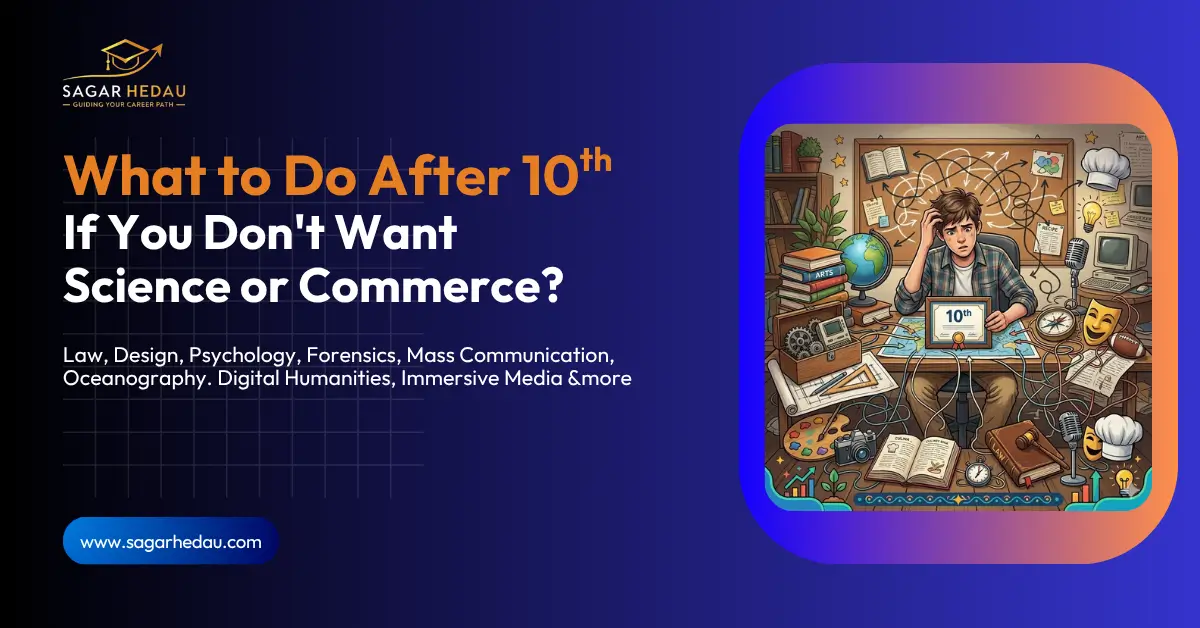
If you have already decided that Science and Commerce are not for you, you aren’t falling behind; you are stepping into the future-proof era of 2026. The old belief that the Arts are a ‘dead end’ is now an actively harmful myth; in reality, the 2026 economy rewards human judgment and problem framing over rote technical ability.
This guide is the ultimate roadmap for what to do after 10th if you don’t want Science or Commerce. Whether you choose the academic depth of Class 11 Humanities or the practical agility of vocational training, we will show you how to utilise the ‘Hybrid Education Model’ to pair the Arts with high-ROI skills like AI Prompt Engineering and UX Research.
From decoding the best entrance exams like CUET and NID DAT to revealing how specialised professionals are earning ₹25+ LPA, this is the only strategy you need to convert your interests into a financially viable, elite career.
Quick Reality Check: Some of India’s highest-earning professionals today are lawyers, UX designers, content strategists, forensic analysts, hydrologists, and sound engineers. None of them needed Science or Commerce as their primary stream.
Table of Contents
- What to Do After 10th If You Don’t Want Science or Commerce?
- Path 1: The Humanities (Arts) Stream and Why It Is Having a Moment
- Path 2: Vocational and Skill-Based Courses for Early Career Entry
- High-Salary Career Goals Without Maths: The Realistic Picture
- Five Career Paths Every Student Should Know About (Open to Any Stream)
- 15 Offbeat Careers With Serious Income Potential in 2026
- Emerging 2026 Frontiers: Where Humanities Meets Technology
- What to Do After 10th If You Don’t Want Science or Commerce?
- Skill Add-Ons: How to Ensure a High Salary Regardless of Your Stream
- Step-by-Step Roadmap: From Class 10 to Professional
- Common Mistakes to Avoid After 10th
- Frequently Asked Questions
- Can Arts students earn more than Science students?
- What are the highest-paying courses after 12th Arts without Maths?
- Is it better to do a degree or a vocational course?
- How do I know which stream is right for me if I am not sure?
- What about career clusters? How do they help with stream selection?
- What are the best career options after 12th for any stream?
- Conclusion: Strategy Over Stream
What to Do After 10th If You Don’t Want Science or Commerce?
No one wants the same traditional fields anymore. People are exploring business opportunities with skills and education. So, you have to know what is suitable for you in the long run, and as a 10th pass student, you should start doing thorough research about various fields that have good career paths.
For everyone, AI, medical, and engineering are not suitable. Everyone does not have the same aptitude. Also, the world needs other professionals as well. So, expand your horizons and think on a broader basis.
The following paths will make you think more.
Path 1: The Humanities (Arts) Stream and Why It Is Having a Moment
What the Arts Stream Actually Builds?
The Humanities stream teaches you things that machines genuinely cannot replicate. Reading depth. Analytical thinking. The ability to construct a clear argument and communicate it to another human being. Writing that moves people to act.
In a world where AI is automating routine tasks at scale, these skills are becoming more valuable, not less. Companies need people who can ask the right questions, frame complex problems, and communicate decisions to different audiences. That is a humanities graduate’s core competency.
Future-Proofing with Liberal Arts in the Age of AI
If you are reading this in 2026, you already know that AI tools can write code, crunch data, and generate reports. What AI still struggles with is context, judgment, ethics, and creativity. Those are exactly what a well-trained Arts student develops. This breakdown of careers in India that AI cannot replace is worth reading before you finalise any stream decision.
Class 11 and 12 Subject Strategy for Arts Students
The subjects you pick in Class 11 can quietly open or close doors. Here is how to think about it strategically:
- Humanities with Psychology: Sets you up for careers in HR, UX research, counselling, and behavioural science.
- Humanities with Economics: Opens doors to social research, policy, journalism, and MBA programmes without requiring PCM-level Maths.
- Humanities with Political Science: Strong foundation for law, civil services, journalism, and public policy.
- Humanities with Fine Arts or Music: Legitimate career paths in design, entertainment, and cultural industries when paired with digital skills.
Path 2: Vocational and Skill-Based Courses for Early Career Entry
What Vocational Training Actually Means in 2026?
Vocational education has changed significantly in the last decade. It is no longer just about learning a trade in a workshop. Today it covers everything from industrial skills to IT-based roles, and the best programmes are certified by the National Skill Development Corporation (NSDC), which means employers actually recognise the qualifications.
The core advantage of this route is speed. You can complete a focused programme in 6 months to 2 years and enter the job market well before a traditional degree student graduates.
Top Vocational Trades Worth Considering in 2026
Technical Trades
- Electrician: One of the highest-demand trades in India. Residential, commercial, and industrial demand remains steady regardless of the economy.
- Mechanic (Automotive or Industrial): Electric vehicle growth is creating new specialisations within this field, making it more future-ready than ever.
- Welder and Fabricator: Infrastructure projects across India continue to drive strong demand for skilled welders.
IT and Digital Trades
- Web Designer: Short learning curve, high demand from small businesses, and a strong freelance market.
- Video Editor: With OTT platforms and social media consumption growing every year, this is one of the fastest paths to freelance income.
- Data Entry and Computer Operator: Entry-level roles that build your confidence with digital tools while you develop more specialised skills on the side.
Creative and Design Trades
- Fashion Design: India’s garment and fashion industry is substantial, and regional fashion is growing.
- Interior Design: Real estate construction and home renovation drive consistent demand.
- Graphic Design: Possibly the most versatile creative skill. Pairs with almost any interest area you can name.
Salary Snapshot: Entry-level vocational roles in India currently earn between Rs. 15,000 and Rs. 35,000 per month. With 2 to 3 years of experience and a good portfolio, this number rises significantly, especially in IT and design trades.
Before you decide between a vocational route and a degree, read this detailed comparison: Degree vs Diploma in India (2026): Salary, Career Scope and Smart Career Choices. It lays out the tradeoffs honestly.
High-Salary Career Goals Without Maths: The Realistic Picture
Here are the four most powerful high-salary destination careers available to Arts stream students.
Law (BA LLB): The Long Game That Pays Off
Law is one of the few careers where your salary can grow without a ceiling for your entire professional life. The path is demanding: 5 years of integrated BA LLB after Class 12, followed by years of practice or corporate employment.
The rewards are real. According to current salary data, corporate lawyers at top-tier Indian firms earn between Rs. 12 to 60 LPA, with senior partners and advocates earning considerably more. Specialisations in intellectual property, corporate law, and technology law are seeing the strongest demand.
The key to making law pay is specialisation. Students from any stream can pursue BA LLB after Class 12.
Design (B.Des and UI/UX Design): Where Creativity Meets Technology
Design is arguably the most exciting career path for Arts students in 2026. The demand for designers who understand both visual communication and user psychology has never been higher.
According to Glassdoor data updated March 2026, the average UX designer in India earns Rs. 10 LPA, with senior designers at product companies earning Rs. 18 to 35 LPA and above. Freelance designers with a strong portfolio often earn more than their salaried counterparts.
Entry points include a B.Des degree from NID, NIFT, or NATA-approved institutions, or shorter UX certification programmes paired with a strong portfolio. Students from any stream can apply.
Psychology and Behavioural Science: The Quiet Powerhouse
Psychology has quietly become one of the most versatile undergraduate degrees a student can pursue. The applications have expanded far beyond the traditional counselling room.
| Psychology Track | Where It Leads | Salary Range |
| Clinical Psychology | Therapy, Hospital Practice | Rs. 4 to 12 LPA |
| HR and Organisational Psychology | People Analytics, Talent Management | Rs. 6 to 18 LPA |
| UX Research | Product Teams, Tech Companies | Rs. 8 to 22 LPA |
| Behavioural Economics | Marketing, Policy Research | Rs. 8 to 20 LPA |
| Industrial-Organisational Psychology | Corporate Consulting | Rs. 10 to 25 LPA |
For a deeper look at what psychology graduates are doing in 2026, this guide to career opportunities in psychology covers the full landscape.
BBA (Bachelor of Business Administration): The Corporate Fast Track for Arts Minds
A student from any stream can pursue BBA after Class 12. The degree opens direct entry into marketing, operations, HR, and business development roles. BBA followed by MBA is the clearest path from Humanities to corporate leadership.
Five Career Paths Every Student Should Know About (Open to Any Stream)
These five fields do not get enough attention in standard career counselling conversations, which is exactly why they are worth knowing about. Students from any stream can pursue all of them.
Psychology
Psychology sits at a unique intersection: it is rigorous enough to be taken seriously in corporate, clinical, and research settings, yet accessible enough that students from any stream can pursue a BSc or BA in Psychology after Class 12.
Beyond the traditional counselling and therapy route, strong demand now exists in HR and people analytics, UX research, behavioural economics, organisational development, and mental health platforms.
Plan for a 5-year commitment: 3 years undergraduate, then a Master’s degree (MA or MSc) to significantly improve your earning potential and the range of roles available.
Where it leads: Clinical Psychologist, HR Business Partner, UX Researcher, Behavioural Consultant, School Counsellor, Organisational Development Specialist
Salary data (2026): Payscale India: average Psychology professional earns Rs. 4.5 to 18 LPA depending on track and specialisation
One thing to know: The degree alone is not enough. A Master’s degree opens significantly better-paying roles. Clinical and corporate psychology tracks have very different salary trajectories.
Forensic Science
Forensic Science is one of the most misunderstood fields in Indian career counselling. Students who show interest are often told it has no jobs in India. That is an outdated view.
Forensic professionals work across police departments, central investigation agencies, private forensic labs, legal firms, cybercrime cells, and academic institutions. With cybercrime rising sharply, digital forensics in particular is seeing strong demand from both government and private sector employers.
Science students have a slight advantage for lab-based tracks, but Humanities students can enter through legal and investigative tracks, especially when combined with a law degree or criminology certification.
Where it leads: Forensic Analyst, Crime Scene Investigator, Digital Forensics Specialist, Forensic Document Examiner, Legal Consultant (Forensics), Cybercrime Analyst
Salary data (2026): ERI SalaryExpert 2026: Digital Forensics Analysts in India average Rs. 15 to 25.5 LPA; entry-level forensic scientists start at Rs. 3 to 6 LPA
One thing to know: Certification in digital forensics tools like EnCase or Autopsy alongside your degree dramatically improves employability in the private sector, where salaries are considerably higher.
Mass Communications and Journalism
Mass Communications is one of the most underrated degrees in terms of career versatility. Graduates find themselves employable across digital media, corporate communications, public relations, social media strategy, podcast production, documentary filmmaking, and content marketing.
A BA or BMC (Bachelor of Mass Communication) is available at universities across India, including well-regarded programmes at Symbiosis, Jamia Millia Islamia, and Mumbai University. Students from any stream can apply.
The field has changed enormously. The skill set transfers broadly because communication is not a department in any organisation. It is the connective tissue of every department.
Where it leads: Journalist, Digital Content Strategist, PR and Communications Manager, Social Media Lead, Documentary Filmmaker, Corporate Communications Executive, Podcast Producer
One thing to know: Your portfolio matters more than your marks in this field. Start a blog, YouTube channel, podcast, or campus newspaper from day one. Employers in media hire based on work samples, not transcripts.
Oceanography
Oceanography is one of India’s most underleveraged career fields. India has a coastline of over 7,500 kilometres and a rapidly expanding blue economy that includes fisheries, offshore energy, coastal tourism, marine research, and climate science.
The National Institute of Oceanography (NIO), Ministry of Earth Sciences, ISRO’s ocean monitoring programmes, and international research institutions all employ oceanographers. Offshore oil and gas, marine environmental consulting, and climate research are also growing employer segments.
Science students with Physics, Chemistry, and Biology have a more direct path into technical tracks. However, roles in science communication, marine policy, coastal resource management, and environmental education are accessible to students from broader backgrounds.
Where it leads: Marine Scientist, Ocean Data Analyst, Coastal Resource Manager, Climate Researcher, Environmental Consultant (Marine), Marine Policy Analyst, Science Communicator
Salary data (2026): ERI SalaryExpert 2026: Hydrologists and marine scientists in India average Rs. 11 to 19.5 LPA; senior roles at international research institutions earn significantly more
One thing to know: Postgraduate qualifications (MSc or PhD) carry significant weight, particularly for research roles. Treat the undergraduate degree as the first step in a longer journey.
Sound Engineering
Sound Engineering is one of the clearest examples of a career where talent and skill matter far more than stream background. Students from Arts, Commerce, and Science all enter the field successfully.
Sound engineers work across music recording, live events, film and television post-production, gaming, podcasting, broadcasting, and increasingly in spatial audio for AR and VR environments. India’s entertainment industry in Mumbai, Chennai, and Hyderabad has consistent demand for skilled sound professionals.
Diploma and degree programmes are offered by SAE Institute, AAFT, Whistling Woods, and FTII. Duration ranges from 1-year diplomas to 3-year degree programmes.
Where it leads: Recording Engineer, Live Sound Engineer, Post-Production Sound Editor, Foley Artist, Audio Designer (Gaming), Podcast Producer, Broadcast Technician, Music Producer
Salary data (2026): ERI SalaryExpert 2026: Sound Engineers in India average Rs. 9.4 to 15.8 LPA; Mumbai-based professionals earn approximately 10% above the national average
One thing to know: Internships and assistant roles at studios are the primary pipeline into this field. Academic qualifications open the door, but hands-on studio experience is what employers actually evaluate you on.
15 Offbeat Careers With Serious Income Potential in 2026
The careers below are underrepresented in most counselling conversations. That gap is precisely what makes them valuable to know about. Each field has genuine demand, real income potential, and limited competition from well-informed candidates. Students from any stream can pursue most of them.
Language and Culture
1. Subtitling and Dubbing Artist
The OTT boom has created massive and sustained demand for subtitling and dubbing professionals. Netflix, Amazon Prime, Disney+ Hotstar, and dozens of regional platforms need content localised across 22 scheduled Indian languages, plus international markets.
Experienced dubbing artists and subtitle editors working with major streaming platforms earn Rs. 8 to 20 LPA. Senior translators and dubbing directors for premium productions earn considerably more. The entry barrier is relatively low: strong language skills, training in voice modulation, and familiarity with subtitling software like Aegisub or EZTitles.
Where it leads: Dubbing Artist, Subtitle Editor, Localisation Specialist, Voice Director, Language Quality Analyst.
Salary data (2026): Indeed India: Subtitling and localisation specialists earn Rs. 3 to 8 LPA entry-level, rising to Rs. 12 to 22 LPA for senior localisation managers
One thing to know: Regional language proficiency is a major differentiator. If you are fluent in two or more Indian languages, your market value increases significantly.
2. Cryptolinguist and Language Analyst
Cryptolinguists work at the intersection of language and intelligence. They analyse communication patterns, decode language signals, and provide language intelligence support to government agencies, defence organisations, and increasingly to large international corporations doing regional risk assessment.
This is a niche field in India, but it is growing. The defence sector, intelligence services, and large-scale translation firms that work with classified or sensitive information are the primary employers. Internationally, cryptolinguists command Rs. 12 to 30 LPA and above.
Where it leads: Language Intelligence Analyst, Translation Specialist (Classified), Regional Analyst (Corporate Risk), Defence Language Specialist.
One thing to know: This career typically requires both language expertise and government security clearance. Starting through a regional language or foreign language degree and then building specialised credentials is the most accessible path.
3. Lexicographer
Lexicographers build and maintain dictionaries, glossaries, and language databases. In 2026, this job will no longer be confined to publishing houses. Tech companies like Google, Microsoft, and AI firms that train large language models need lexicographers to build and curate training data.
Demand is growing specifically from AI companies building language models for Indian regional languages, where high-quality linguistic data is scarce. Rs. 8 to 18 LPA is realistic for professionals with strong language credentials and digital familiarity.
Where it leads: Lexicographer, Language Data Curator, Linguistic Quality Analyst, AI Training Data Specialist, Dictionary Editor.
One thing to know: A postgraduate degree in linguistics or a specific language, combined with familiarity with corpus linguistics tools, makes you highly competitive for the technology-sector positions that pay the best.
Science and Environment
4. Hydrogeologist
Water scarcity is India’s next major infrastructure crisis. Groundwater levels are declining across major agricultural states, and the demand for specialists who can locate, assess, and manage underground water resources has never been higher.
Hydrogeologists work for government bodies like the Central Ground Water Board and National Institute of Hydrology, infrastructure firms, agricultural consultancies, and international water-focused NGOs. The field requires a science background, ideally in geology, earth science, or environmental science.
Where it leads: Hydrogeologist, Groundwater Analyst, Environmental Geoscientist, Water Resource Consultant, Disaster Risk Analyst.
Salary data (2026): Glassdoor India Feb 2026: Hydrogeologists average Rs. 6.75 LPA; top earners reach Rs. 15.75 LPA
One thing to know: A Master’s degree in hydrogeology or water resource management, combined with GIS and groundwater modelling software skills (MODFLOW, QGIS), positions you for both government and private sector roles.
5. Wildlife Forensics Specialist
Wildlife forensics is an emerging field in India that combines forensic science with ecology and conservation. Wildlife forensics specialists work with the Wildlife Crime Control Bureau, forest departments, conservation NGOs, and international organisations like TRAFFIC and WWF to investigate poaching, illegal wildlife trade, and habitat crime.
This is a small but growing field with almost no trained specialists in India, which means early entrants face limited competition. A background in zoology, forensic science, or biotechnology is the most direct entry route.
Where it leads: Wildlife Forensics Analyst, Conservation Scientist, Wildlife Crime Investigator, NGO Research Officer.
One thing to know: International organisations in this space often offer salaries significantly above government pay scales. Building a research track record through publications or fieldwork dramatically improves your prospects at this level.
6. Fragrance Chemist and Perfumer
A fragrance chemist, sometimes called a perfumer or nose, develops and formulates scents for personal care products, cosmetics, household products, and luxury perfumes. India has a significant presence in the global fragrance supply chain, with companies supplying to Hindustan Unilever, ITC, Marico, and international fragrance houses like Givaudan and Firmenich.
This career sits at the intersection of chemistry and creativity, which makes it rare and highly valued. Senior perfumers at major FMCG firms and fragrance houses earn Rs. 10 to 35 LPA. The path requires a chemistry background, ideally with specialisation in organic chemistry or natural products.
Where it leads: Fragrance Chemist, Perfumer, Flavourist, Sensory Scientist, Product Development Chemist (FMCG).
One thing to know: Formal training at institutes like the Indian School of Business and Finance (ISBF) or international perfumery schools is available. The combination of a chemistry degree and perfumery training is unusual enough to command premium salaries.
Creative and Technical
7. Foley Artist
A Foley artist creates the everyday sound effects that you hear in films, TV shows, and video games, using physical objects in a sound studio. The footsteps on a gravel path, the rustle of a costume, the clinking of keys: these are typically created in post-production by a Foley artist, not recorded on set.
India’s film industries in Mumbai, Chennai, Hyderabad, and Kolkata have a continuous need for skilled Foley professionals. This is a distinct specialisation from general sound engineering, and specialists in this niche are genuinely scarce.
Where it leads: Foley Artist, Foley Supervisor, Sound Effects Editor, Post-Production Sound Specialist.
Salary data (2026): ERI SalaryExpert: Sound and post-production specialists in Mumbai average Rs. 10.4 to 16 LPA at entry to senior levels
One thing to know: The entry route is almost always through an assistant or apprentice role at a post-production studio. Formal sound engineering training at FTII or SAE Institute builds the technical foundation.
8. Museum Curator and Exhibition Designer
Museum curation combines art history, cultural studies, spatial design, and storytelling into a single profession. Curators and exhibition designers work for national and state museums, private art galleries, heritage organisations, and increasingly for corporate art collections and hospitality brands that invest in cultural programming.
India’s museum sector is expanding, with new private museums, cultural centres, and heritage tourism projects attracting both domestic and international visitors. This career rewards depth of knowledge and a sensitivity to how objects and spaces communicate meaning.
Where it leads: Museum Curator, Exhibition Designer, Heritage Manager, Gallery Director, Cultural Programme Manager, Corporate Art Consultant.
One thing to know: A postgraduate degree in Museum Studies, Art History, or Cultural Heritage Management is the standard entry qualification for senior roles. A portfolio of exhibition projects or curatorial work is equally important for career advancement.
Technology-Adjacent
9. AI Trainer and Domain-Specialist Data Annotator
Not all AI training work is equal. The low-paid, high-volume data annotation jobs often described online are not the roles we are talking about here. Senior AI trainers who specialise in a specific domain, such as law, medicine, regional languages, or financial services, provide the expertise that AI companies cannot replicate with generalist workers.
These specialists review AI outputs, create high-quality training datasets, and design evaluation frameworks for large language models. Demand comes from AI labs, technology companies, and outsourcing firms building AI products for enterprise clients.
Where it leads: Senior AI Trainer, Domain Expert Annotator, AI Evaluation Specialist, LLM Quality Analyst, Prompt Quality Engineer.
Salary data (2026): Scaler data 2026: Specialist AI trainers with domain expertise earn Rs. 12 to 25 LPA in India; international remote roles offer Rs. 20 to 40 LPA
One thing to know: The value is entirely in the domain expertise you bring, not in the data annotation work itself. A lawyer, doctor, or financial professional who can evaluate AI outputs in their domain is significantly more valuable than a generalist.
10. Digital Archivist
Digital archivists preserve institutional knowledge by digitising physical records and managing digital collections for governments, hospitals, universities, corporations, and cultural institutions. India’s push toward digital governance and the digitisation of historical records has created sustained demand for professionals who understand both information management and digital tools.
This career is accessible to students from Humanities backgrounds, particularly those with training in library science, history, or information management. The role increasingly requires familiarity with metadata standards, digital preservation tools, and cloud-based content management systems.
Where it leads: Digital Archivist, Records Manager, Information Governance Specialist, Knowledge Manager, Digital Preservation Officer.
One thing to know: A postgraduate diploma or Master’s in Library and Information Science (LIS) with a digital specialisation is the most direct qualification. Government institutions, universities, and large corporations are the primary employers.
11. Haptics Designer
A haptics designer designs the tactile feedback that you feel when you interact with a device: the vibration of a notification, the resistance of a button press in a VR controller, or the sensation feedback in a medical simulator. As devices become more sophisticated and VR and AR technology matures, haptic design is becoming a critical discipline.
This is still a nascent field in India, but internationally it is one of the highest-paying niches in product design. Indian companies building hardware, medical simulation, and immersive tech products are beginning to hire for this role.
Where it leads: Haptics Designer, Interaction Designer, Embedded UX Specialist, VR Experience Designer, Medical Simulation Designer.
One thing to know: This career currently has the highest salary potential internationally, particularly in the US and Europe, where experienced haptics designers earn the equivalent of Rs. 50 to 80 LPA+. Building this specialisation with a base in product design or electronics engineering is the most viable path.
Offbeat Business and Social
12. Subtitling Entrepreneur / Regional Language Content Strategist
This is a derivative of the subtitling career, but it deserves its own mention. A Regional Language Content Strategist helps brands and media companies develop content strategies for specific regional audiences in India.
As Tier 2 and Tier 3 city consumers come online and demand content in their own languages, companies that built only Hindi and English content are discovering they need specialists who understand how Marathi, Tamil, Telugu, Kannada, Bengali, and other regional audiences actually think and consume media.
Where it leads: Regional Content Strategist, Regional Marketing Lead, Localisation Manager, OTT Content Producer (Regional), Brand Manager (Regional Markets).
One thing to know: This is one of the few careers where being from a non-metro city and speaking a regional language as your mother tongue is a direct professional advantage, not just a personal attribute.
13. Grief Counsellor and Palliative Care Specialist
Grief counselling and palliative care are genuinely emerging professions in India. With life expectancy increasing and awareness of mental health growing, demand for trained professionals who work with terminally ill patients and bereaved families is growing sharply across hospitals, hospices, and private practice.
This career requires serious professional training: a background in psychology or social work, followed by specialised certification in palliative care or grief counselling. It is not a casual entry. But for students with a genuine orientation toward care work, it combines meaningful work with steady income growth.
Where it leads: Grief Counsellor, Palliative Care Specialist, Bereavement Support Worker, Hospital Chaplain, End-of-Life Doula.
One thing to know: Private hospitals and corporate wellness programmes are beginning to fund this role more consistently. Private practice rates for experienced grief counsellors in metro cities can reach Rs. 3,000 to 8,000 per session.
14. Urban Farmer and Vertical Farm Consultant
Urban farming and vertical farming represent one of the more genuinely surprising career paths on this list. India produces a significant portion of the world’s vegetables, but food security, supply chain inefficiency, and growing consumer demand for local and pesticide-free produce are driving investment in urban and indoor farming.
Consultants who help restaurants, hotels, corporate campuses, and food companies set up indoor or rooftop farms are in demand, and there are almost no trained specialists in India. The field has a low barrier to entry through self-education and hands-on experimentation, combined with a growing number of short courses from organisations like the Indo-Dutch Horticulture Technologies Centre.
Where it leads: Urban Farm Consultant, Vertical Farm Manager, Agritech Entrepreneur, Hydroponics Specialist, Corporate Sustainability Manager (Food).
One thing to know: The commercial opportunity in this field is significant for entrepreneurially minded students. Early movers who can demonstrate working farms and successful client projects command premium consulting rates.
15. Instrument Repair Specialist and Luthier
A luthier builds and repairs stringed instruments: guitars, violins, sitars, and other instruments. This is a highly specialised trade with almost no competition in India at the professional level.
The market for high-quality instrument repair and custom-built instruments is small but consistent, and professional clients, including touring musicians, institutions, and collectors, pay premium rates for skilled work.
This career is less about income scale and more about income stability and creative autonomy. A skilled luthier in a city like Mumbai, Chennai, or Bengaluru can build a stable, independent practice serving a loyal client base.
Where it leads: Luthier, Instrument Repair Specialist, Custom Instrument Builder, Music School Technician.
One thing to know: Training is available through apprenticeship with established luthiers, international correspondence courses, and some music conservatories. The European Guild of Luthiers and the Chicago School of Violin Making offer correspondence programmes accessible to Indian students.
Emerging 2026 Frontiers: Where Humanities Meets Technology
This is where things get genuinely exciting. The most interesting new career paths of 2026 sit at the intersection of language, culture, and technology, which is exactly where humanities education has always lived.
Prompt Engineering: The Career Built on Language
Prompt engineering is the practice of crafting precise, effective instructions that guide AI systems to produce useful outputs. Its core skill is language. According to current salary data from Scaler and Glassdoor, entry-level prompt engineers in India earn Rs. 5 to 7 LPA, with experienced specialists earning Rs. 20 to 35 LPA. Companies across sectors are actively hiring for this role.
Digital Humanities: Where History Meets Data
Digital Humanities (DH) applies computational tools to cultural and historical questions. It is growing rapidly in archives, museums, publishing houses, cultural institutions, and policy organisations. A combination of a Humanities degree with basic data tools and digital archiving skills can position you ahead of the curve in this still-emerging field.
Digital Storytelling and Immersive Media
The frontier now includes AR and VR narratives, interactive documentaries, branded podcasts, and immersive experience design. Students with a strong base in literature, history, or visual arts, combined with skills in scriptwriting, video editing, and digital production, are well-positioned for this space.
What to Do After 10th If You Don’t Want Science or Commerce?
A big concern, actually and worth exploring instead of the traditional medical, engineering and IT domains. In my experience as a career counsellor, I have had multiple parents and even students willing to explore careers in Arts, Psychology, Forensics, Mass Communications and even fields like Oceanography and Sound Engineering.
So, people are willing to look beyond the traditional career paths. Even the kids whose parents are doctors are moving away from the medical field and career. This might be due to the extreme competition or just an interest in other career tracks. Still, it is a healthy choice. Only if it is explored properly with stats and opportunities. Let’s explore these tracks.
Skill Add-Ons: How to Ensure a High Salary Regardless of Your Stream
The Hybrid Model: Why Traditional Education Alone Is Not Enough
Here is a truth most schools will not tell you: a degree, on its own, is increasingly a floor, not a ceiling. What separates a Rs. 4 LPA Arts graduate from a Rs. 14 LPA one is almost always an additional skill layer. This is what we call the Hybrid Model: Traditional Education + Skill Development = Career Success. This article on why skill development matters more than degrees in 2026 is a recommended read.
High-Yield Skill Combinations for Arts Students
| Core Background | Skill Add-On | Career It Unlocks | Salary Potential |
| English / Literature | SEO and Content Strategy | Content Marketer, SEO Lead | Rs. 5 to 18 LPA |
| Psychology | HR Analytics or UX Research | People Analyst, UX Researcher | Rs. 8 to 22 LPA |
| History / Political Science | Policy Research Methods | Policy Analyst, Think Tank Researcher | Rs. 6 to 16 LPA |
| Economics (without Maths) | Data Visualisation (Tableau/Power BI) | Business Analyst, Research Associate | Rs. 7 to 18 LPA |
| Fine Arts / Design | UI/UX Tools (Figma, Adobe XD) | UI/UX Designer, Brand Designer | Rs. 8 to 25 LPA |
| Any Humanities Subject | Prompt Engineering | AI Content Specialist | Rs. 6 to 20 LPA |
| Languages (Regional) | Localisation and Dubbing | Regional Content Strategist | Rs. 8 to 20 LPA |
| Forensic / Law | Digital Forensics Tools | Cybercrime Analyst | Rs. 10 to 25 LPA |
The Non-Negotiable: Digital and Presentation Literacy
Whatever path you choose, these three capabilities will determine whether you get shortlisted:
- Digital Tools Proficiency: Google Workspace, Microsoft Office, Canva, and at least one domain-specific tool relevant to your field.
- Data Interpretation: You do not need to be a data scientist. But you need to be able to read a graph, understand a percentage change, and draw a basic conclusion from a dataset.
- Presentation Skills: The ability to communicate clearly in front of others, both in person and on video calls, is now a baseline professional expectation across almost every industry.
Step-by-Step Roadmap: From Class 10 to Professional
The Academic Path: Humanities Degree to Professional Career
- Complete Class 10 and choose the Humanities stream in Class 11.
- Select subjects strategically based on your target career (see Section II).
- Prepare for entrance exams alongside Class 12: CUET for most central universities, NID DAT and UCEED for design, NIFT for fashion and textile design, and CLAT for law.
- During Class 12, begin one online skill course in your target domain. Even 2 hours per week over a year builds a meaningful base.
- In the first year of your undergraduate programme, begin building a portfolio or a body of work. This matters more than your grades for most creative and strategic roles.
- In your third year, actively pursue internships. These often convert to job offers.
The Vocational Path: ITI or Polytechnic to Early Employment
- Complete Class 10 and choose a vocational trade that matches both your interest and market demand in your region.
- Enrol in an ITI (Industrial Training Institute) or a Polytechnic programme. Duration is typically 1 to 3 years.
- Pursue NSDC (National Skill Development Corporation) certification alongside your training.
- Apply for apprenticeship programmes while studying. Many companies offer stipends of Rs. 8,000 to Rs. 15,000 per month.
- After 1 to 2 years of work experience, consider upgrading qualifications through a part-time diploma or certification to move into supervisory roles.
A Note on Education Loans
Education loans for undergraduate programmes are available from all major public sector banks under the government’s Vidya Lakshmi portal. Banks typically require proof of admission before processing the loan. So the sequence is: secure your admission first, then apply for the loan.
If you are uncertain about which path fits your natural strengths, career guidance after 10th is specifically designed for students at this exact junction.
Common Mistakes to Avoid After 10th
Mistake 1: The Passion Trap
Everyone has heard the advice: “Follow your passion.” It is genuinely well-intentioned. But it sets a trap for students who interpret it as “whatever I love will automatically pay me.”
Passion is a starting point, not a business model. The question to ask is not “What do I love?” but “What do I love enough to get good at, and is there a market for that skill?” When you can answer both parts of that question, you have a career. When you can only answer the first, you have a hobby.
Mistake 2: Choosing a Generic Path in a Specialised World
In 2026, “I want to be in marketing” or “I want to work in content” is not a plan. It is a starting sentence. The difference between earning Rs. 4 LPA and Rs. 16 LPA in the same industry is almost always specialisation.
Mistake 3: Ignoring the Career Planning Step Entirely
Many students choose a stream without a career plan. They assume the plan will reveal itself somewhere during the degree. It rarely does without deliberate effort. Understanding why having a career plan matters is worth reading right now, not after you graduate.
Mistake 4: Letting Marks Define Your Options
Board exam marks matter for some specific entrance exams. But they are a much smaller factor in long-term career success than most students and parents believe. This guide on how board exam marks actually affect your career gives an honest, evidence-based perspective.
Frequently Asked Questions
Can Arts students earn more than Science students?
Yes, and it happens regularly. Salary is determined by the value you deliver to an employer or client, not by the stream you studied in Class 11 and 12. A UX designer with a Humanities background can earn more than a Biology graduate who did not specialise further. The variable is skill and positioning, not stream.
What are the highest-paying courses after 12th Arts without Maths?
In 2026, the highest-paying routes for Arts graduates without Maths include: Law (BA LLB), Design (B.Des with a focus on UI/UX), Psychology followed by I-O or UX specialisation, BBA followed by MBA in Marketing or Strategy, and Digital Marketing or Content Strategy with a strong portfolio. Salary outcomes range from Rs. 6 LPA to Rs. 35 LPA and above depending on the role and specialisation.
Is it better to do a degree or a vocational course?
Neither is universally better. The better question is: what does the specific role or industry you want to work in actually require? The Hybrid Model, a degree combined with targeted skill development, produces the best outcomes for most students. This guide to the best diploma courses in India in 2026 covers high-salary options with faster entry points.
How do I know which stream is right for me if I am not sure?
A structured psychometric assessment is the most reliable tool for this. It evaluates your aptitude, interests, and personality together. This guide on MBTI personality types and careers is a useful starting point for understanding personality-based career matching.
What about career clusters? How do they help with stream selection?
Career clusters are broad groupings of related careers that share common skills and knowledge. This explanation of why career clusters matter is a useful framework for students at this stage.
What are the best career options after 12th for any stream?
The full picture is broader than this article can cover. This complete guide to the best career options after 12th covers the full spectrum of what is available once you complete Class 12.
Conclusion: Strategy Over Stream
The stream you choose after 10th is a door, not a destiny. Science graduates fail to build meaningful careers. Arts graduates build remarkable ones. The difference is never the stream. It is always the strategy.
In 2026, clarity beats motivation. A student who knows exactly which skill they are building, which market they are targeting, and which steps they are taking next will consistently outperform a student who studied the right stream without a plan.
You do not need Science. You do not need Commerce. You need a clear direction, a willingness to develop real skills, and the patience to build something over time.
That is a plan any stream can support.
Next Step: If you are still uncertain about which path fits your specific strengths and interests, consider a one-on-one career counselling session or a psychometric assessment. A 60-minute conversation can save years of trial and error.