That Big Dream Starts Right Here, at Class 10
Every year, thousands of Class 10 students sit with one dream burning quietly in the background: becoming an IAS officer. Maybe a relative inspired you, maybe it was a documentary, or maybe it is simply that feeling that you want to do something that genuinely matters for this country.
But the moment you start asking around, the confusion begins. Your science teacher says science builds logical thinking. Your parents insist that humanities students have an edge because of the syllabus overlap with UPSC.
A random YouTube video tells you that 60% of UPSC toppers were engineers. And you are sitting there in the middle of all this noise, trying to figure out what is actually true.
This article is your no-nonsense, career counsellor’s guide. I am not going to tell you what sounds good. I am going to tell you what actually works, and more importantly, why it works.
If you are still figuring out the broader question of what to study after Class 10, the guide on what stream to choose after 10th covers all your options before you narrow it down to the UPSC angle.
Table of Contents
- 1. Does Your Stream Actually Matter for UPSC? (The Eligibility Reality Check)
- 2. Understanding the UPSC Exam Structure Before Choosing a Stream
- Which Stream is Best for UPSC After 10th? Arts vs Science
- 4. Commerce for UPSC: The Underrated Contender
- 5. Comparative Analysis: Stream Strengths and Challenges for UPSC
- 6. Optional Subject Selection: How Your Stream Should Inform This Decision?
- 7. Phase-wise Preparation Timeline: From Class 10 to UPSC Prelims
- 8. What UPSC Toppers Actually Say: IAS Topper Strategy Across All Streams
- 9. Medium of Instruction: Does Stream Choice Affect the Language You Can Use in UPSC?
- 10. How to Actually Decide: A Career Counsellor’s Framework
- 11. Stream Self-Assessment Checklist: Use This Before You Decide
- 12. Frequently Asked Questions About Stream Choice for UPSC
- Conclusion: Mindset is the Real Stream
1. Does Your Stream Actually Matter for UPSC? (The Eligibility Reality Check)
Let me start with the most important fact that most people overlook entirely. “Which Stream is Best for UPSC After 10th?”
UPSC does not care about your Class 10 or Class 12 stream. The only eligibility requirement for the Civil Services Examination is a graduation degree from a recognised university in any subject. Whether you studied Physics or Philosophy, History or Hotel Management, you are eligible to sit for the exam.
So why does everyone make such a big deal about stream selection?
Because stream choice is not about eligibility. It is about preparation, synergy and syllabus overlap. The stream you choose will shape how you think, how you write, how you analyse problems, and how naturally the UPSC syllabus comes to you when serious preparation begins. That is what makes this decision worth discussing carefully.
Think of it this way. The destination is the same for everyone. But the road you take will determine how much energy you spend getting there.
For a broader look at what your options are after Class 10, the list of courses after 10th is a helpful starting point before committing to any stream.
2. Understanding the UPSC Exam Structure Before Choosing a Stream
Before comparing streams, you need to understand what the Civil Services Examination actually tests. Many students make stream decisions without ever looking at the exam pattern, which is a fundamental mistake.
You can verify the latest syllabus directly on the official UPSC website (upsc.gov.in). Here is the essential structure:
- Preliminary Examination (Prelims): Two papers. GS Paper I covers History, Geography, Indian Polity, Economy, Environment, and General Science. CSAT Paper II tests reading comprehension, logical reasoning, and basic mathematics. CSAT is qualifying in nature but must be taken seriously.
- Main Examination (Mains): Nine papers, including an Essay, four GS papers covering Indian heritage, governance, economy, environment, ethics and integrity, and one Optional subject of your choice from a list of 48 subjects.
- Personality Test (Interview): Assesses your personality, communication style, awareness, and suitability for civil service.
The most critical thing to note here is that the GS papers are the core of the exam. They span a vast range of subjects: history, geography, polity, economy, society, environment, international relations, science and technology, and more. Your stream gives you a head start on some of these. No stream covers all of them.
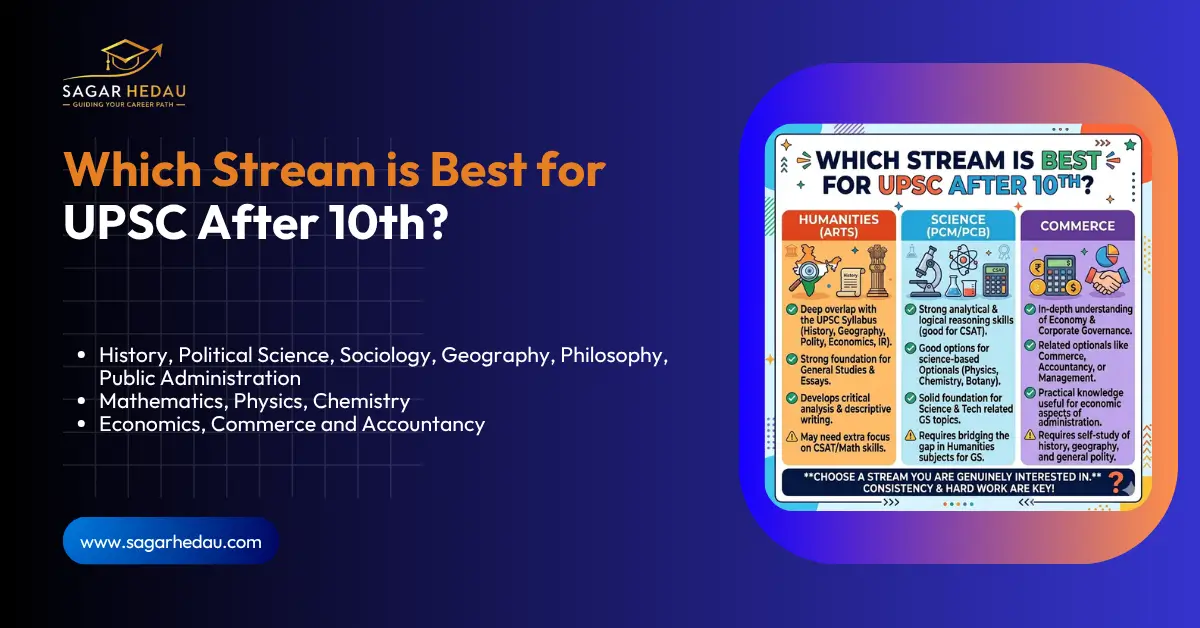
Which Stream is Best for UPSC After 10th? Arts vs Science
The Humanities Argument: Syllabus Overlap and Writing Edge
If you choose Arts or Humanities after 10th, you will study History, Political Science, Geography, Economics, and Sociology in Classes 11 and 12. Place those subjects side by side with the UPSC Prelims and GS Mains syllabus, and you will notice something striking: these are almost directly present in the GS papers.
This is not coincidental. The Civil Services Examination is fundamentally designed to assess whether you understand India’s history, governance structure, economy, and society. Humanities education is built around exactly this kind of understanding.
Additionally, Mains is entirely descriptive. You write long-form answers, analytical paragraphs, and essays. Humanities students spend years doing exactly this in board exams and college work. The writing muscle is already being developed.
The Science Student’s Advantage: CSAT and Analytical Rigour
Here is a statistic that surprises many students: over 57% of the 2020 batch of IAS officers had engineering degrees. Year after year, science and engineering graduates show strong representation in the UPSC merit list.
The reason is not that UPSC favours science. The reason is what science education does to how you think.
- Science students learn to approach problems systematically, breaking complex issues into components and building answers logically. This maps directly onto how a strong UPSC Mains answer is structured.
- Years of JEE or NEET preparation train students to handle massive amounts of information, manage exam pressure, and revise efficiently. This mental framework transfers well to UPSC preparation.
- The CSAT paper involves quantitative reasoning and analytical thinking. Science students generally find this far more manageable than humanities students, who have not touched mathematics in years.
What Science Students Must Work Hard On?
Science students will need to build their humanities base largely from scratch. History, Indian Polity, Art and Culture, and Government Schemes are not subjects that engineering education covers.
This requires additional months of foundational NCERT reading. The descriptive answer-writing style also needs deliberate practice, since science education is primarily about problem-solving and objective answers.
If you are a science student exploring what lies ahead in addition to UPSC, the guide on best career options after 12th science helps you see the full landscape before committing to any single direction.
4. Commerce for UPSC: The Underrated Contender
Commerce students rarely get mentioned in UPSC stream discussions, which is a genuine oversight.
GS Paper III in Mains covers the Indian Economy, Economic Development, Agriculture, Infrastructure, and Internal Security. This is one of the most challenging papers for many candidates.
Commerce students arrive with a natural advantage: their background in Economics, Accountancy, Business Studies, and Taxation gives them a real head start in understanding fiscal policy, budget analysis, inflation, banking, and economic trends.
The data interpretation component of CSAT also comes more naturally to Commerce students, who regularly work with financial statements, graphs, and numerical data throughout Classes 11 and 12.
Where do Commerce Students Need Extra Effort?
The gaps are in History, Indian Polity, Geography, and Art and Culture. These areas require dedicated preparation from the NCERT level upwards. Writing style development is also needed, similar to what science students must work on.
But to be direct: every stream has gaps. Nobody walks into UPSC preparation with 100% of the syllabus already covered. The question is always how large the gap is and how efficiently you can fill it.
5. Comparative Analysis: Stream Strengths and Challenges for UPSC
| Stream | Core UPSC Advantage | Key Challenge | Best For |
| Arts / Humanities | Massive syllabus overlap with GS Papers I and II. Strong descriptive writing. Easier optional subject selection in History, Polity, Geography. | Building competitive exam discipline and analytical rigour from scratch. | Students who love reading, writing, and understanding society and governance. |
| Science / Engineering | High analytical ability. Clear CSAT advantage. Proven competitive exam culture from JEE/NEET preparation. | Must build History, Indian Polity, Art and Culture foundation from scratch. Descriptive writing needs deliberate development. | Disciplined, analytical students comfortable with high-pressure study routines. |
| Commerce | Strong foundation in Indian Economy (GS Paper III). Excellent data interpretation ability for CSAT. Fiscal policy and budget awareness. | Limited exposure to History, Indian Polity, and Art and Culture. Writing style development needed. | Students with interest in economy, public finance, policy, and governance. |
6. Optional Subject Selection: How Your Stream Should Inform This Decision?
This is the section most stream-selection articles skip entirely, and it is one of the most strategically important decisions you will make in your UPSC journey.
The Optional subject counts for 500 marks out of the total 1750 marks in Mains. That means it directly and significantly affects your final rank. Choosing the right option is not a decision to take lightly, and it connects directly to your stream and graduation subject.
The Core Principle: Syllabus Overlap Saves Months of Preparation
When your optional subject aligns with your graduation subject, you arrive with pre-built familiarity. A Political Science graduate choosing Political Science and International Relations as their optional has already covered a significant portion of the syllabus during their degree.
They are reinforcing and deepening knowledge, not starting from scratch. This is a real and meaningful time advantage when preparation time is one of your most valuable resources.
Stream-by-Stream Optional Guidance
| Stream | Naturally Strong Optionals | Popular Neutral Optionals | Why the Neutral Works |
| Arts / Humanities | History, Political Science, Sociology, Geography, Philosophy, Public Administration | Anthropology, Public Administration | These cover society, governance, and culture — areas a humanities student already understands deeply. |
| Science / Engineering | Mathematics, Physics, Chemistry (very high scoring but demanding) | Anthropology, Public Administration, Sociology | No prior degree needed. Concise syllabus. Analytical students can master them efficiently. |
| Commerce | Economics, Commerce and Accountancy | Public Administration, Sociology | Strong policy and governance overlap. Commerce students can pick up administrative concepts quickly. |
Why Science Students Prefer Neutral Optionals?
Which Stream is Best for UPSC After 10th? This question is on every candidate’s mind.
Engineering students frequently choose Anthropology or Public Administration as their optional, even though these seem unrelated to their degree.
The reason is straightforward: both subjects have relatively concise syllabi, do not require prior degree-level background, and reward analytical writing. An engineer’s systematic thinking applies well to these subjects once the foundational reading is done.
Choosing a science-heavy optional like Physics or Chemistry is possible but demands a very high level of specialisation. The marking tends to be tighter, and the effort-to-score ratio is less favourable for most candidates compared to the neutral optionals.
The Graduation Degree Connection
This is worth planning from Class 11 itself. If you choose Humanities and then pursue a degree in History or Political Science, you are building your UPSC optional foundation over six years before you even sit for Prelims. That is a structural advantage that compounds quietly over time.
If you are weighing whether to pursue a full degree or consider alternative qualification routes, the comparison on degree or diploma can help you think through that decision with more clarity.
7. Phase-wise Preparation Timeline: From Class 10 to UPSC Prelims
One of the most common questions students ask me in career counselling sessions is: I want to be an IAS officer. When do I actually start, and what do I do at each stage?
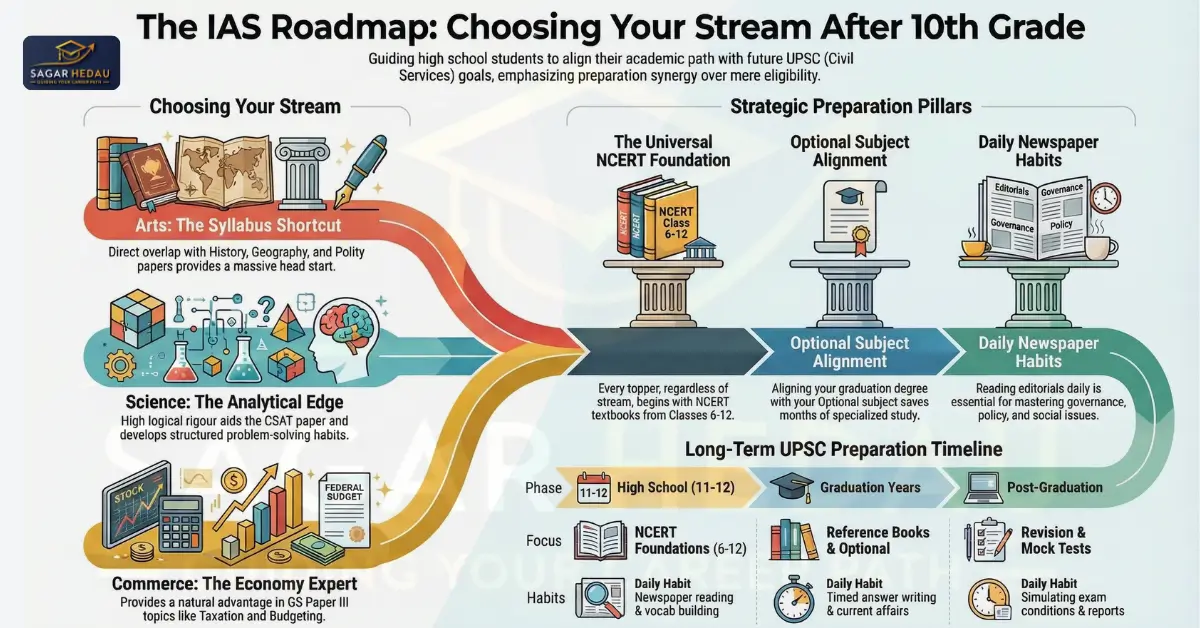
Here is a realistic, phase-wise roadmap that works regardless of your stream. The NCERT Foundation milestones in this table are non-negotiable starting points that every UPSC aspirant, from Arts, Science, or Commerce, must complete before moving to advanced preparation material.
| Phase | Period | Key NCERT Milestone | Daily Habit to Build |
| Phase 1 | Class 11 | Finish NCERT History (6–10), NCERT Polity (6–10), NCERT Geography (6–10) | Read one newspaper daily. Underline unfamiliar terms. Build a vocab notebook. |
| Phase 2 | Class 12 | Finish NCERT Economics (9–12), NCERT Science & Tech (6–10), Revision of Phase 1 NCERTs | Write one 150-word answer per week on any current affairs topic. Develop writing muscle early. |
| Phase 3 | Graduation Year 1 | Complete NCERT set across all GS subjects. Begin standard reference books (Laxmikanth, Spectrum) | Start a current affairs monthly revision document. Read editorials critically. |
| Phase 4 | Graduation Year 2–3 | Optional subject foundation. Previous year question analysis. GS deep dives. | Practice timed answer writing. Attempt mock Prelims tests. Join a study group or peer review circle. |
| Phase 5 | Post-Graduation | Full syllabus revision cycles. Test series. Mains answer writing practice. | Simulate exam conditions. Read Annual Reports, Economic Survey, Budget documents. |
Important Note on This Timeline This is a preparation architecture, not a rigid schedule. The goal in Phases 1 and 2 is habits, not completion pressure. Students who read NCERT books out of genuine curiosity during Class 11 and 12 build a deeper, more durable understanding than those who rush through them as a checklist in their first year of serious preparation.
8. What UPSC Toppers Actually Say: IAS Topper Strategy Across All Streams
The NCERT Foundation is Universal
Across years and across streams, toppers consistently point to one foundational strategy: build your base with NCERT textbooks from Classes 6 to 12, covering all core subjects. Tina Dabi (AIR-1, 2015) emphasised building conceptual clarity from basic sources before moving to advanced material. This approach is available to every student regardless of stream.
Strategy Matters More Than Background
Aditya Srivastava, who topped the 2023 UPSC examination, has stressed that identifying question patterns, building a smart revision strategy, and answering with analytical precision matter far more than having a particular academic background. The exam rewards preparation quality, not stream labels or college prestige.
Newspaper Reading as a Daily Habit
Almost every successful UPSC candidate mentions the habit of reading a quality newspaper daily, ideally starting well before graduation. Whether you are in Science, Commerce, or Arts, developing this habit in Class 11 puts you years ahead of those who start later. The editorial pages of The Hindu or Indian Express are particularly valuable for understanding governance, policy, and social issues in the analytical depth that Mains questions demand.
This also connects to a broader point about genuine interest. Students who love governance and public service tend to sustain UPSC preparation far longer than those doing it purely for job security. The article on how to find your passion in life is something I recommend to every aspirant before they finalise their stream decision.
9. Medium of Instruction: Does Stream Choice Affect the Language You Can Use in UPSC?
This is a question that rarely gets addressed directly, yet it matters enormously for students from regional medium schools across India.
The Short Answer: No, Your Stream Does Not Determine Your Medium
UPSC allows candidates to write the Mains examination in any of the 22 languages listed in the Eighth Schedule of the Constitution, in addition to English. This means a student from a Marathi medium school in Maharashtra, a Hindi medium student from Uttar Pradesh, or a Tamil medium student from Tamil Nadu can write their GS papers, Essay paper, and optional subject answers in their preferred language.
Your stream choice does not restrict this in any way. A Science student can write UPSC answers in Hindi. An Arts student can choose English. The language of instruction in your school and college is separate from the language you use in the UPSC examination.
What You Should Know About Medium Choice
- The English medium has historically had more study material, coaching resources, and answer-writing reference material available. This gap is narrowing, but it still exists.
- Regional language medium candidates who score highly in Mains often do so because they can express nuanced ideas more naturally in their first language. This is a genuine advantage in the Essay and Ethics papers.
- The Interview is generally conducted in the language you declare as your medium. If you declare Hindi, the board may choose to conduct the interview in Hindi. Prepare accordingly.
- CSAT (Paper II) is available in both English and Hindi. For regional language medium candidates, Paper II is still evaluated in the original English or Hindi version. Keep this in mind during preparation.
The practical advice here is straightforward: prepare in the language in which you can think, write, and analyse most effectively. Do not choose English because it seems more prestigious if your conceptual thinking is sharper in your regional language. The exam rewards the quality of ideas, not the language they are packaged in.
10. How to Actually Decide: A Career Counsellor’s Framework
After 13 years of guiding students through stream choices and career decisions, here is the framework I use when a student sits across from me asking this exact question.
Step 1: Assess Genuine Interest, Not Perceived Prestige
Which subjects do you genuinely enjoy studying? Not which ones your family considers impressive. If you can spend three hours reading about the Mughal Empire without feeling bored, the Humanities is likely a natural home.
If you genuinely enjoy solving problems and understanding how systems work, Science may serve your preparation better. UPSC preparation takes anywhere from two to seven years for most candidates. Genuine interest is not optional.
Step 2: Look at Your Strengths Objectively
- Are you strong in writing, reading comprehension, and analytical essays? Humanities will feel natural.
- Are you strong in logical reasoning, problem-solving, and systematic study? Science suits your preparation style.
- Are you strong in numerical analysis, data interpretation, and economic thinking? Commerce gives you a real head start in GS Paper III.
Step 3: Do Not Chase Topper Trends
Just because many toppers are engineers does not mean engineering is your best route to UPSC success. Toppers are engineers who also happen to have exceptional discipline, preparation strategy, and intellectual ability.
The stream was one variable in a complex equation. UPSC toppers have cleared the exam with optional subjects ranging from Medical Science to Sanskrit Literature. The exam has no preferred stream.
Step 4: Match Your Stream to Your Optional Subject Plan
Think now, before you even finish Class 10, about what optional subject you might want to pursue in Mains. If History genuinely excites you, choose Humanities, take History in graduation, and let your optional preparation grow organically over six years.
If you are drawn to Public Administration or Anthropology, this works well from any stream. Planning the optional subject alignment early is one of the highest-leverage decisions a future UPSC aspirant can make.
Step 5: Think About Sustainability Over Five to Seven Years
The stream you can maintain with energy, curiosity, and discipline is the right stream, regardless of what statistics say. The relationship between consistent effort and success is something I explore in detail in how do you define success in life, which many UPSC aspirants find useful as a mindset reference throughout the preparation journey.
11. Stream Self-Assessment Checklist: Use This Before You Decide
Print this, keep it on your desk, and answer honestly. This checklist has no right or wrong answers. It is designed to help you hear your own instincts more clearly than the noise around you.
| Checklist Item | What It Points To |
| I genuinely enjoy reading about history, governance, and society. | Arts / Humanities |
| I prefer solving problems, working with data, and logical analysis. | Science / Engineering |
| I find economics, budgets, and financial news genuinely interesting. | Commerce |
| I have already prepared for a competitive exam (JEE / NEET / boards at high level). | Science advantage |
| I want to start newspaper reading in Class 11 itself. | All streams |
| I am ready to build descriptive writing skills from Class 11. | All streams |
| I want an optional subject with syllabus overlap with my graduation degree. | Match your stream above |
| I can sustain study in this field for the next 5 to 7 years. | This is the deciding question |
12. Frequently Asked Questions About Stream Choice for UPSC
-
Does UPSC give preference to any specific stream?
No. UPSC does not record or consider your Class 11 or 12 stream during the examination process. All candidates are evaluated equally on the basis of their performance in Prelims, Mains, and the Interview.
-
Can a student from a vernacular medium school do well in UPSC?
Yes, without question. UPSC has been cleared by students from rural backgrounds, regional medium schools, and cities with no formal coaching infrastructure. The language you study in school does not determine your UPSC outcome. Your preparation quality does. The medium of writing in Mains is your choice, and the exam genuinely accommodates strong thinkers in their preferred language.
-
Should I pick Humanities just because it looks like the obvious choice for UPSC?
No. Trend-chasing is one of the biggest mistakes students make in stream selection. Choose Humanities because you genuinely enjoy those subjects. Choosing it purely for perceived UPSC alignment and then discovering in Class 11 that you dislike the subjects is a costly mistake that sets preparation back by years.
-
What if I choose Science but want to write my UPSC Mains in Hindi?
There is no conflict. Your stream and your UPSC medium are completely independent decisions. You can be a Science student who writes UPSC Mains in Hindi with a Political Science optional. UPSC does not impose any relationship between these choices.
-
Is there a perfect stream for UPSC?
No. There is only the stream that is right for you. Humanities gives you a syllabus overlap. Science gives you analytical strength and an exam preparation culture. Commerce gives you economic depth. Each comes with gaps that a strong preparation strategy must fill. The stream where you can study with sustained passion and discipline is your ideal stream, full stop.
You can also explore broader options through the list of courses after 10th to understand what each stream opens up beyond UPSC before you make your final decision.
Conclusion: Mindset is the Real Stream
After all the analysis, the comparison tables, the topper insights, and the optional subject strategies, here is the truth I want you to take away from this article.
UPSC does not select streams. It selects mindsets.
The officer who cleared UPSC from a small town in Bihar, studying on a cracked phone screen, and the engineer from IIT who spent three years preparing in Delhi, both arrived at the same result through completely different paths. What they shared was not a stream. What they shared was consistency, intellectual curiosity, a willingness to keep going after failure, and a genuine desire to serve.
Choose the stream where you will study with energy and purpose. Build the newspaper-reading habit early. Develop your writing. Understand India deeply. And let the preparation do what preparation always does when it is done with the right mindset.
The stream is the vehicle. You are the driver. Choose wisely, but more importantly, drive well.
Need personalised guidance on stream selection or UPSC preparation strategy? As a career counsellor with 13+ years of experience, I work directly with students to build a preparation roadmap that fits their strengths and goals.
Explore more career guidance articles on the blog or reach out directly for a personalised session.
Understanding how different careers and fields connect also helps in choosing a direction confidently. The article on why career clusters are important offers a useful framework for thinking about this.