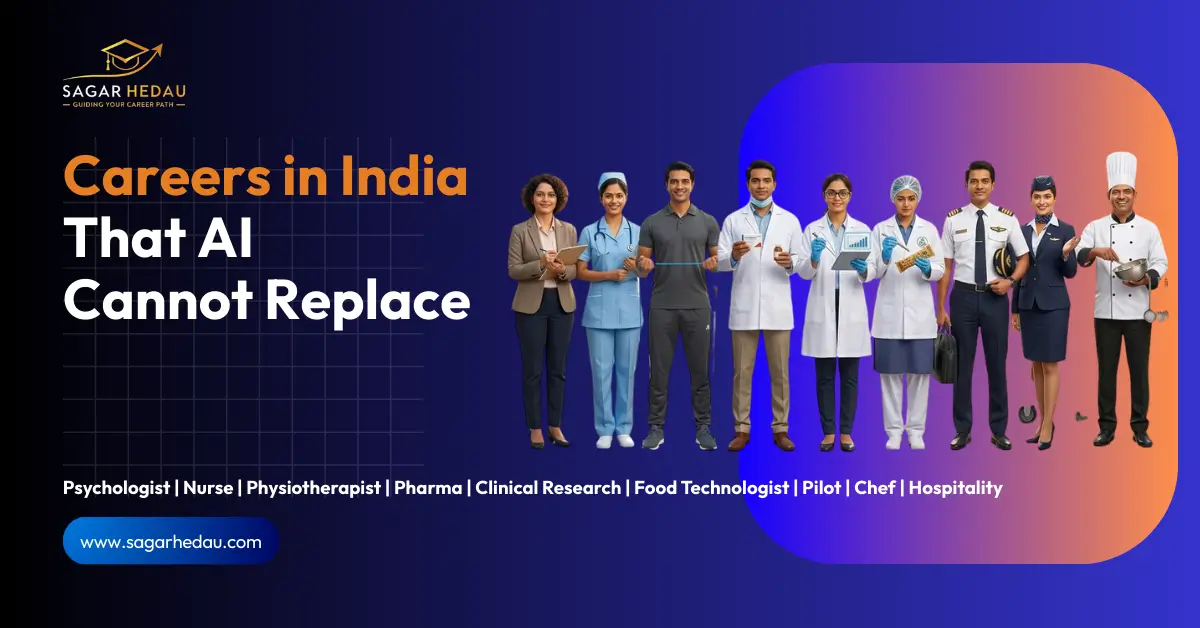
What are the careers in India that AI cannot replace?
AI is changing the job market, but it cannot replace careers that depend on human touch, physical skill, or ethical judgment. In India, 9 such careers remain genuinely safe from automation in 2026, and all of them are hiring. These fields work because they require a licensed professional to be physically present, emotionally available, or sensorially engaged in ways no machine can replicate.
India’s healthcare sector alone needs over 2.4 million additional workers by 2030, and sectors like aviation, food technology, and hospitality are growing faster than the talent pipeline. In this guide, you will find salary data, entry qualifications, and career outlook for each of these 9 careers, so you or your child can choose with confidence.
Written by Sagar Hedau, a certified career counsellor with 14 years of experience guiding Indian students and parents towards the right career path.
Every parent and student in India today is asking the same question: “Will this career still exist in 10 years?“
It is a fair concern. AI tools can now write code, analyse medical scans, draft legal documents, and handle customer queries. Millions of jobs in data entry, basic accounting, and content moderation are already being automated. The fear is real.
But here is what most articles miss: AI replaces tasks, not entire professions. And there is a large group of careers built around skills that machines genuinely cannot replicate: human empathy, physical touch, ethical decision-making, creative sensory judgement, and face-to-face relationships.
This guide covers 9 such careers. Each one is in demand in India right now, each one pays a growing salary, and not one of them is at serious risk from automation in the foreseeable future.
If you want a deeper understanding of how to choose the right career from these options, read our complete guide on career counselling for students.
Table of Contents
- What are the careers in India that AI cannot replace?
- Why are some careers safe from AI in India?
- 10 careers in India that AI cannot replace in 2026
- Quick comparison: AI-resistance across all 9 careers
- How to choose the right career from this list?
- Common FAQS About Careers in India that AI cannot replace
- The bottom line
Why are some careers safe from AI in India?
Before we get to the list, it helps to understand why these careers are protected.
AI is extremely good at pattern recognition, data processing, and predicting outcomes from large datasets. It is poor at physical dexterity, genuine human empathy, ethical judgment in ambiguous situations, and sensory tasks that require taste, touch, or smell.
The careers on this list share one or more of these qualities:
- They require a licensed professional to take physical or ethical responsibility for outcomes
- They involve direct human-to-human contact that patients, clients, or customers demand
- They depend on senses or physical skills that robots cannot yet replicate economically in India
- They are regulated by law, meaning a qualified human must be present regardless of what technology does
India’s healthcare sector alone is projected to need over 2.4 million additional health workers by 2030, according to government estimates. The food processing industry, aviation sector, and hospitality industry are all growing faster than the talent pipeline. These are not sunset careers. They are sunrise careers that happen to be stable.
10 careers in India that AI cannot replace in 2026
1. Psychology
Why AI cannot replace it: A psychologist’s core work is the therapeutic relationship itself. Patients dealing with anxiety, trauma, depression, or grief need to feel genuinely heard and understood.
AI chatbots can provide information and even basic coping prompts, but they cannot replicate the nuanced, trust-based bond between a trained psychologist and a client. Clinical judgement, ethical responsibility, and the ability to read unspoken distress are deeply human skills.
India has fewer than 0.3 psychologists per 1,00,000 people, against the WHO-recommended figure of 3. Mental health awareness is growing rapidly, particularly among students and young professionals, and demand for qualified psychologists is rising sharply across hospitals, schools, corporates, and private practice.
Salary in India (2026):
| Level | Annual Salary Range |
|---|---|
| Fresher (0-2 years) | ₹3 – ₹5 LPA |
| Mid-level (3-7 years) | ₹6 – ₹12 LPA |
| Senior / Specialist | ₹12 – ₹22 LPA |
Specialisations such as organisational psychology, forensic psychology, and neuropsychology command higher salaries at the upper end.
Courses to pursue: BA/BSc Psychology, MA/MSc Clinical Psychology, MPhil Clinical Psychology (RCI-recognised), PhD Psychology
Growth outlook: High. Corporations are actively hiring psychologists for employee wellness programmes. Schools are mandated to have counsellors. Private practice in metro cities is increasingly viable.
Read our detailed guide: Career Opportunities in Psychology in India
2. Nursing
Why AI cannot replace it: Nursing is fundamentally physical and relational. A nurse assesses a patient by touching, observing, and listening. They administer injections, dress wounds, monitor vital signs in real time, and provide emotional support to frightened patients and their families.
An AI system can flag an anomaly in a patient’s data, but it cannot hold a patient’s hand, calm a child before surgery, or make a rapid clinical judgement at 3 AM in a hospital ward.
India’s nurse-to-patient ratio is significantly below the ideal level, creating sustained demand for trained nurses across government hospitals, private hospitals, nursing homes, and international placements. Indian nurses are also in high demand in Gulf countries, the UK, Australia, and Canada.
Salary in India (2026):
| Level | Annual Salary Range |
|---|---|
| Fresher (BSc Nursing) | ₹2.5 – ₹4 LPA |
| Staff Nurse (3-5 years) | ₹4 – ₹6 LPA |
| Senior / Specialist Nurse | ₹6 – ₹10 LPA |
Government nurses under the Pay Commission structure earn ₹4 – ₹10 LPA with additional benefits. ICU, OT, and paediatric nurses typically earn at the higher end of the range.
Courses to pursue: ANM, GNM, BSc Nursing, Post Basic BSc Nursing, MSc Nursing
Growth outlook: Very high. India needs to add hundreds of thousands of nurses to its healthcare workforce over the next decade. International placements offer significantly higher earnings for qualified nurses.
Read our detailed guide: Career Opportunities in Nursing in India
3. Physiotherapy
Why AI cannot replace it: Physiotherapy is hands-on by definition. A physiotherapist manually assesses muscle strength, joint mobility, and pain responses. They design and physically supervise rehabilitation programmes for patients recovering from strokes, surgeries, sports injuries, and neurological conditions.
The physical manipulation involved, from dry needling to manual therapy, requires trained human hands. No robot currently performs physiotherapy in Indian hospitals at any meaningful scale.
Demand is growing rapidly due to India’s ageing population, rising lifestyle diseases such as diabetes and obesity, and an expanding sports and fitness culture. Corporate wellness programmes are increasingly including physiotherapy as a standard offering.
Salary in India (2026):
| Level | Annual Salary Range |
|---|---|
| Fresher (BPT) | ₹2.5 – ₹3.5 LPA |
| Mid-level (3-7 years) | ₹4 – ₹7 LPA |
| Senior / Private Practice | ₹8 – ₹12 LPA |
Physiotherapists working with IPL cricket teams, national sports associations, or premium hospitals earn significantly more. Those running their own clinic in a metro city can cross ₹12 LPA within five to seven years.
Courses to pursue: BPT (Bachelor of Physiotherapy), MPT (Master of Physiotherapy), certifications in sports physiotherapy or neurotherapy
Growth outlook: High. Ageing population, urban lifestyle diseases, and the growing sports industry are all driving demand. Private practice in tier-1 and tier-2 cities is increasingly profitable.
Read our detailed guide: Career in Physiotherapy in India
Not sure which of these careers suits your personality and strengths?
A proper psychometric assessment and one-on-one career counselling session can help you identify the right fit from these options, before you invest years in a course. Book a career counselling session with Sagar Hedau and get a clear direction within one session.
4. Pharmacy
Why AI cannot replace it: A pharmacist’s role goes well beyond dispensing medicines. They review prescriptions for errors, check for dangerous drug interactions, counsel patients on dosage and side effects, and collaborate with doctors on medication therapy.
Clinical pharmacists in hospitals make real-time decisions about patient medication plans. In regulatory roles, they ensure drug safety and compliance. These tasks require a professional licence, ethical accountability, and a depth of clinical knowledge that AI tools assist with but cannot independently perform.
India’s pharmaceutical industry is one of the largest in the world and is growing steadily. Demand for pharmacists is strong across hospitals, retail pharmacy chains, pharmaceutical manufacturing companies, clinical research organisations (CROs), and regulatory bodies.
Salary in India (2026):
| Role | Annual Salary Range |
|---|---|
| Retail / Hospital Pharmacist (Fresher) | ₹2 – ₹3.5 LPA |
| Hospital Pharmacist (3-5 years) | ₹4 – ₹8 LPA |
| Clinical / Industrial Pharmacist | ₹6 – ₹15 LPA |
| Regulatory Affairs / R&D | ₹8 – ₹20 LPA |
Specialising in pharmacovigilance, clinical research, or regulatory affairs can take a pharmacy graduate’s salary significantly higher than the general average.
Courses to pursue: D.Pharm, B.Pharm, M.Pharm, Pharm.D, MBA in Pharmaceutical Management
Growth outlook: Strong. India’s pharma industry is targeting significant growth through 2030, and the country is a global leader in generic drug manufacturing and clinical trials, creating consistent demand for pharmacy professionals.
Read our detailed guide: Career Opportunities in Pharmacy in India
5. Clinical Research
Why AI cannot replace it: Clinical research involves running trials that test whether new drugs and medical devices are safe and effective in real human patients.
A Clinical Research Associate (CRA) visits hospital sites, verifies patient data, ensures ethical compliance, and monitors adverse events.
This requires human judgment, physical site visits, relationship management with doctors, and legal accountability.
AI can help with data analysis and anomaly detection, but the on-ground monitoring, ethical oversight, and regulatory accountability must be handled by a qualified human professional.
India has become one of the world’s top destinations for clinical trials, with over 4,000 registered trials active as of 2025. Global CROs such as IQVIA, Parexel, and ICON have large operations in India and are consistently hiring.
Salary in India (2026):
| Role | Annual Salary Range |
|---|---|
| Clinical Research Coordinator (Fresher) | ₹2.5 – ₹4 LPA |
| Clinical Research Associate (1-3 years) | ₹4 – ₹8 LPA |
| Senior CRA / CDM (5+ years) | ₹10 – ₹22 LPA |
India’s clinical trials market is growing at over 12% per year, and the demand for qualified CRAs consistently outpaces supply, which keeps salaries rising.
Courses to pursue: B.Pharm / M.Pharm / BSc / MSc Life Sciences (entry qualification), followed by a post-graduate diploma or certificate in Clinical Research (PGDCR), Good Clinical Practice (GCP) certification
Growth outlook: Very strong. India’s position as a global hub for clinical trials is only growing, and experienced professionals are scarce relative to demand.
Read our detailed guide: Career Opportunities in Clinical Research in India
6. Food Technology and Food Industry
Why AI cannot replace it: Food technology involves the science of processing, preserving, testing, and innovating food products. It requires physical sensory evaluation, taste, smell, and texture, which no machine has yet been able to replicate in professional food development.
A food technologist developing a new product for a snack brand needs to taste and refine formulations. A food safety officer inspecting a processing plant needs to be physically present. A quality control professional must smell, feel, and assess samples by hand.
India’s food processing industry is one of the largest in the world, employing millions and growing steadily. FMCG companies, government food safety bodies (FSSAI), research institutions, and export firms all hire food technology graduates.
Salary in India (2026):
| Level | Annual Salary Range |
|---|---|
| Fresher (BSc/BTech Food Technology) | ₹2.5 – ₹4.5 LPA |
| Mid-level (3-5 years) | ₹5 – ₹10 LPA |
| Senior (R&D, QA management) | ₹10 – ₹20 LPA |
Roles in research and development at FMCG companies and MNCs typically offer the highest packages. Food safety officers in government positions have stable salaries and job security.
Courses to pursue: BSc Food Technology, BTech Food Technology, MTech Food Technology, BSc Food Science and Nutrition, PG Diploma in Food Safety
Growth outlook: Solid. India’s food processing sector is a government-priority industry, and growing health-consciousness among consumers is driving demand for qualified food scientists and R&D professionals.
Read our detailed guide: Career in the Food Industry in India
7. Aviation (Cabin Crew and Pilots)
Why AI cannot replace it: Aviation is one of the most human-critical industries in the world. Pilots make split-second decisions during emergencies that require experience, calm, and judgment that no autopilot or AI system can fully replicate in all scenarios.
Cabin crew manage passenger safety, handle medical emergencies mid-flight, and provide the human face of air travel that passengers expect and trust. The Civil Aviation Authority requires licensed, physically present crew on every commercial flight; this is a legal requirement that will not change.
India is set to become the world’s third-largest aviation market. Airlines, including IndiGo, Air India, and Akasa Air, are expanding their fleets significantly, and the demand for trained pilots and cabin crew is set to outstrip supply for years.
Salary in India (2026):
| Role | Annual Salary Range |
|---|---|
| Cabin Crew / Air Hostess (Fresher) | ₹4.5 – ₹6 LPA |
| Senior Cabin Crew (5-8 years) | ₹8 – ₹15 LPA |
| Commercial Pilot (First Officer) | ₹18 – ₹30 LPA |
| Captain (Senior) | ₹40 – ₹80 LPA+ |
Cabin crew at international airlines earn significantly more, with tax-free income and accommodation included in some cases.
Courses to pursue: Aviation certificate courses and BBA Aviation for cabin crew; Commercial Pilot Licence (CPL) via DGCA-approved flying schools for pilots
Growth outlook: Very high for pilots. India faces a projected shortfall of thousands of pilots over the next decade. Cabin crew demand is also growing with airline fleet expansions.
Read our detailed guide: Career in the Aviation Industry in India
8. Hospitality
Why AI cannot replace it: Hospitality is built entirely on human experience. When a guest checks into a five-star hotel, they are paying for warmth, attentiveness, personalised care, and the feeling of being looked after by another human being.
AI can manage bookings and send automated messages, but it cannot replace the hotel manager who remembers a returning guest’s preferences, the relationship manager who handles a difficult situation with grace, or the events coordinator who brings a wedding to life. The higher the tier of hospitality, the more human presence matters.
India’s tourism and hospitality sector is growing rapidly, particularly with the expansion of business travel, destination weddings, and domestic tourism to tier-2 cities. Hotel chains, resorts, cruise lines, and event management companies all recruit hospitality graduates consistently.
Salary in India (2026):
| Role | Annual Salary Range |
|---|---|
| Front Office / Guest Services (Fresher) | ₹2.5 – ₹4 LPA |
| Supervisor / Assistant Manager | ₹5 – ₹9 LPA |
| Hotel Manager / Senior Manager | ₹10 – ₹25 LPA |
International hotel brands and luxury properties offer higher salaries and faster career growth. Professionals with experience at premium properties and overseas exposure command a premium.
Courses to pursue: BSc Hospitality and Hotel Administration, BHM (Bachelor of Hotel Management), IHM (Institute of Hotel Management) programmes, post-graduate diplomas in hospitality management
Growth outlook: Strong. India’s hospitality sector is expanding, with new hotel openings in tier-2 and tier-3 cities driven by the government’s focus on domestic tourism. Skilled professionals with the right attitude are consistently in demand.
Read our detailed guide: Career in the Hospitality Industry in India
9. Professional Cooking (Chef)
Why AI cannot replace it: Cooking at a professional level is one of the most deeply human-sensory crafts in existence. A chef tastes, smells, and adjusts in real time. They lead kitchen teams, manage pressure under service, innovate menus based on seasonal ingredients, and build the reputation of a restaurant through consistency and creativity.
Robotic kitchen assistants exist for repetitive tasks in fast food, but fine dining, catering, cloud kitchens, and hotel kitchens all require skilled human chefs. A robot cannot taste whether a gravy needs more salt, and it certainly cannot read a dining room.
India’s food service industry is growing rapidly, driven by urban eating-out culture, the boom in cloud kitchens, the expansion of hotel chains, and a growing appetite for both Indian and international cuisine. Skilled chefs are consistently in short supply relative to demand.
Salary in India (2026):
| Role | Annual Salary Range |
|---|---|
| Commis Chef / Fresher | ₹2 – ₹3 LPA |
| Chef de Partie / Senior Chef | ₹4 – ₹8 LPA |
| Executive Chef / Head Chef | ₹12 – ₹30 LPA+ |
Chefs at five-star hotels, international cruise lines, and well-known restaurant brands earn at the higher end. Culinary entrepreneurs who build their own brand restaurant, cloud kitchen, or content have virtually no ceiling.
Courses to pursue: Certificate / Diploma in Culinary Arts, BSc Culinary Arts, hotel management degree with specialisation in F&B production, IHM programmes
Growth outlook: Strong and growing. Cloud kitchens have created thousands of new opportunities. The demand for skilled chefs who understand both cooking and kitchen management is genuinely high.
Read our detailed guide: How to Become a Professional Chef in India?
Quick comparison: AI-resistance across all 9 careers
| Career | Starting Salary (LPA) | AI Risk Level | Primary Degree |
|---|---|---|---|
| Psychology | ₹3 – ₹5 | Very Low | BA/BSc, MA Psychology |
| Nursing | ₹2.5 – ₹4 | Very Low | ANM / GNM / BSc Nursing |
| Physiotherapy | ₹2.5 – ₹3.5 | Very Low | BPT |
| Pharmacy | ₹2 – ₹3.5 | Low | D.Pharm / B.Pharm |
| Clinical Research | ₹2.5 – ₹4 | Low | B.Pharm / BSc + PGDCR |
| Food Technology | ₹2.5 – ₹4.5 | Low | BSc / BTech Food Technology |
| Aviation (Cabin Crew) | ₹4.5 – ₹6 | Very Low | 12th pass + aviation certification |
| Hospitality | ₹2.5 – ₹4 | Very Low | BHM / IHM |
| Professional Cooking | ₹2 – ₹3 | Very Low | Culinary diploma / BHM |
Salary ranges are for fresh graduates at the entry level. All figures are indicative and vary by city, employer, and qualification. Sources: Payscale, Naukri, Indeed India, and industry salary surveys (2025-26).
How to choose the right career from this list?
Knowing that a career is AI-proof is only half the answer. The other half is knowing which of these careers actually suits you or your child.
Each of these nine careers requires a different personality profile. Nursing and physiotherapy demand physical stamina and emotional resilience. Psychology requires patience and the ability to sit with someone’s pain without fixing it immediately.
Clinical research suits people who are detail-oriented and comfortable with structured processes. Aviation requires confidence, communication, and adaptability. Cooking demands creativity combined with precision and a high tolerance for pressure.
Choosing the wrong career because it appears “safe” is just as risky as choosing one that might be automated. What you actually need is the right match between personality, strengths, and career path, and that match is something a proper career assessment can help identify clearly.
There are a few practical questions to ask yourself:
Do you prefer working with people or with processes?
Nursing, psychology, and hospitality are deeply people-facing. Pharmacy, clinical research, and food technology have more process and lab-based elements.
Are you comfortable with physical work?
Nursing, physiotherapy, and professional cooking involve significant physical activity. Aviation involves irregular hours and travel.
What is your subject background?
Most healthcare and science careers require PCB (Physics, Chemistry, Biology) in 11th and 12th. Hospitality and aviation are accessible after any stream.
Do you want job security or income ceiling?
Government healthcare jobs (nurses, pharmacists, physiotherapists) offer security. Private practice, senior hotel management, or executive chef roles offer higher income with more variability.
If you are struggling to answer these questions, a structured career counselling session with a psychometric assessment can make things significantly clearer for students and for parents who are making decisions on their behalf.
Read more: What stream to choose after 10th for a stable career?
Common FAQS About Careers in India that AI cannot replace
-
Will AI eventually replace doctors and nurses, too?
AI is already assisting doctors with diagnostic imaging and early detection. But the physical, legal, and ethical responsibility of patient care will remain with licensed professionals. AI is a tool that healthcare workers use; it does not replace the healthcare worker.
-
Is it worth studying these careers even if salaries start low?
Yes, for most of them. Starting salaries in healthcare careers are modest but grow steadily with experience. More importantly, these careers offer strong job security in a market where many white-collar jobs are at risk. A nurse with five years of experience, earning ₹6 LPA with government benefits and job security, is in a significantly stronger position than a data entry professional earning slightly more with no job security.
-
Which of these careers offers the fastest salary growth?
Clinical research and pharmacy (specifically regulatory affairs and pharmacovigilance) offer the fastest salary growth among this list. A CRA who moves from a fresher role at ₹3 LPA to a senior CRA role in four to five years can reach ₹15 – ₹20 LPA. Aviation offers the highest absolute salary ceiling for pilots, but the upfront training cost is significant.
-
Can arts stream students pursue any of these careers?
Yes. Aviation (cabin crew), hospitality, and professional cooking are all accessible to students from the arts or commerce stream after class 12. Psychology can be pursued after any stream at the undergraduate level. Most healthcare and science careers require the science stream with Biology.
Read more: Best career options for students who do not want science or commerce after 10th
The bottom line
AI will change the way every profession works. Nurses will use AI-assisted monitoring tools. Physiotherapists will use AI-generated rehab programmes as starting points. Chefs will use AI for menu cost optimisation. Clinical researchers will use AI for data analysis.
But in every one of these careers, the human professional remains essential as the decision-maker, the ethical guardian, the physical practitioner, and the face another human being trusts.
These are not careers you choose because they are safe from automation. They are careers you choose because they are deeply human, consistently in demand, and paid well for those who commit to building genuine expertise.
The question is not whether AI will affect these fields. It is whether you are building the kind of skills that AI cannot replicate. That is the real career strategy for 2026 and beyond.
Still unsure which of these careers is the right fit for you?
Sagar Hedau offers one-on-one career counselling sessions for students in classes 10, 11, and 12, as well as for graduates who are reassessing their direction. Sessions include a psychometric assessment to identify your personality type, strengths, and career alignment so you can decide with clarity, not guesswork.
Book your career counselling session | Learn more about our psychometric assessments