
With thousands of possibilities, little advice, and the pressure to make the “right” decision that might influence decades of life, choosing a career today can feel like being tossed into a huge library without a catalogue. This intricacy frequently causes uncertainty, worry, and bad judgments for parents, kids, and even working professionals.
For this reason, one of the most effective frameworks in contemporary career planning is career clusters. But why are career clusters important?
Career clusters assist people in understanding where they fit in, what talents are important, and how various career pathways relate to one another, rather than pressuring them to select a single job title too soon, especially in a labour market that is changing more quickly than ever before.
This guide examines the significance of career clusters, their operation, and the seven main reasons that they are necessary for professional success in 2026 and beyond.
Table of Contents
- What Are Career Clusters?
- Major Career Cluster Statistics
- Why are career clusters important? 7 Key Points
- 1. Career Clusters Make Exploring Careers Easier
- 2. They Establish a Clear Connection Between Careers and Education
- 3. Career Clusters Encourage Learning Based on Skills
- 4. They Get People Ready for New and Future Careers
- 5. They Make Tailored Career Counselling Possible
- 6. Career Clusters Boost Job Readiness and Employability
- 7. They Encourage Career Flexibility and Lifelong Learning
- Why are career clusters important and matter more in 2026?
- Factors & Facts That Should Influence Your Career Choice
- Career Counselling in India: Still An Underutilised Gem
- Why are career clusters important in career counselling?
- To wrap up the clusters

What Are Career Clusters?
Career clusters are broad groupings of aligned occupations that share common skills, knowledge areas, and industry foundations. Instead of focusing on individual job roles, career clusters organise the world of work into clear, navigable pathways.
Globally, there are 16 widely recognised career clusters, including:
- Health Science
- Information Technology
- Business Management & Administration
- Engineering & Manufacturing
- Hospitality & Tourism
- Arts, Media & Design
- Agriculture & Environmental Sciences
- Education & Training
- Finance
- Law, Public Safety & Governance
Each cluster contains multiple career pathways and roles, allowing individuals to explore options without locking themselves into a single profession too early.
Think of career clusters as a career map, not a destination.
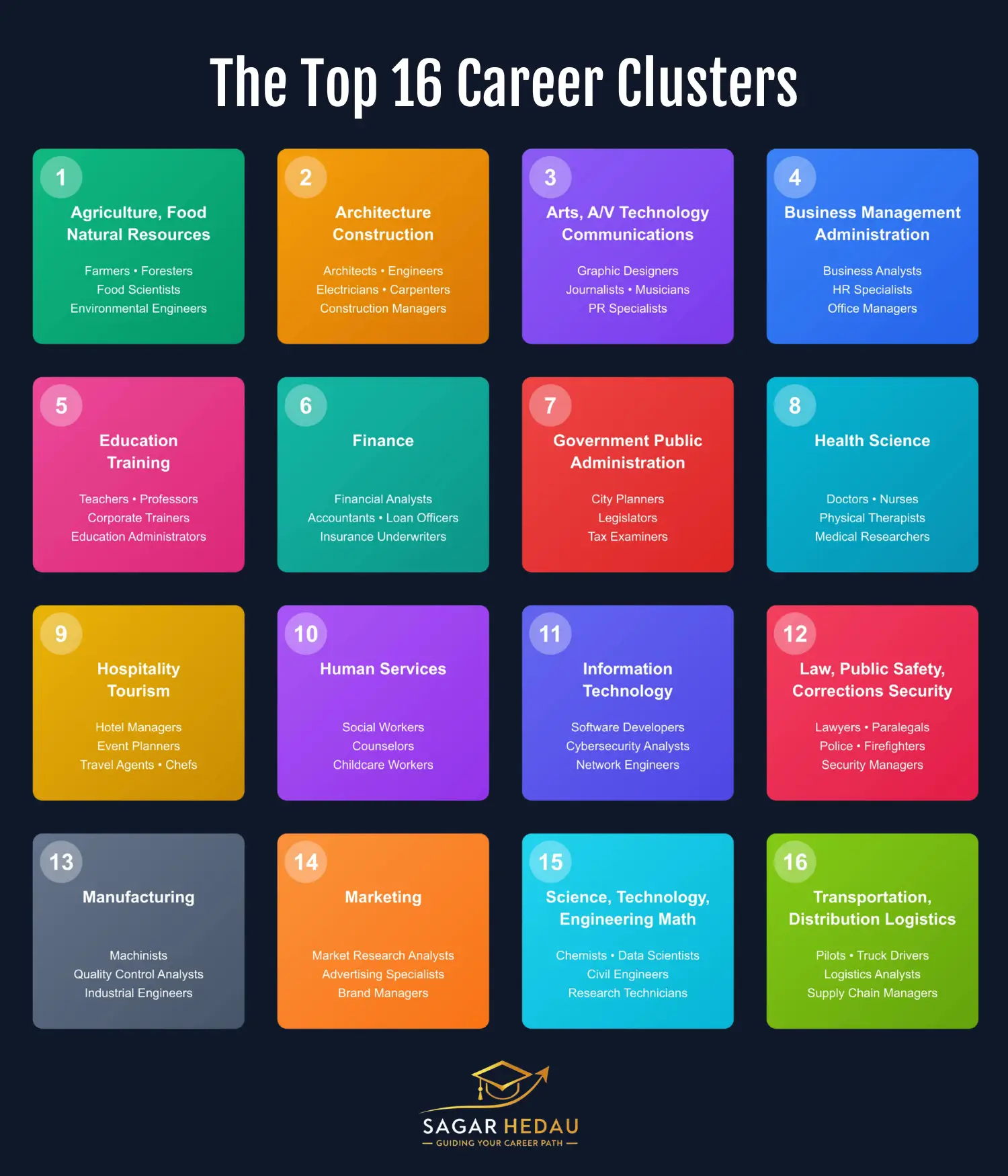
Each career cluster consists of multiple career pathways, which then become specific job roles.
For example, Digital Marketing as a cluster includes jobs in SEO, content writing, Google and Meta Ads, Analytics, Performance Marketing, and Social Media Marketing.
Another example would be Health Sciences or Healthcare. This cluster not only includes Doctors and Nurses, but also Medical Lab Technicians, MRI operators, Pathologists, Radiologists, Dieticians and more.
From this, we can get a clear idea of why career clusters are important. How one field can have multiple job roles, and you can identify which one is the most suitable for you.
Major Career Cluster Statistics
- India’s agriculture sector is still the largest employer, accounting for 39.5% of the total employment.
- The services sector, like IT, retail, telecom and BFSI, is expected to grow by 9% in 2025.
- Low and semi-skilled workers dominate India’s workforce at 57%.
- Graduates taking up AL and ML roles are now at 46%.
- Delhi has the highest employability at 53.4%, followed by Himachal Pradesh at 51.1%.
Why are career clusters important? 7 Key Points
The primary help that career clusters offer is a simplified way to explore your areas of interest and choose the right career option as you enter the professional world.
As I said earlier, there are more than 12000 career options. Out of career options, which one is the most suitable for you and why? You have to understand that choosing a career is all about your interests, likes, and aptitude.
That is why, as a Career Counsellor, I always advise my clients and fellow students to take an Aptitude Test/Psychometric Test.
If you are confused about what your interests are and you are still unsure how to identify your set of interests, this test will help you gain clarity about them.
Based on the above given example, we can easily understand that Medical, Engineering, Law, Marketing, and Information Technology, etc, are career clusters that include multiple job profiles and job roles in them. Here are 7 more reasons why career clusters are important.
1. Career Clusters Make Exploring Careers Easier
Overwhelming information is one of the main obstacles to career planning. It’s simple to be overwhelmed by the thousands of new job titles that are appearing, many of which weren’t around ten years ago.
Career clusters address this through:
- Putting related professions together
- Clearing up misunderstandings during early exploration
- Assisting people to prioritise their broad interests
For instance, a student can investigate the STEM or information technology cluster before focusing on areas like software development, data science, or cybersecurity. This is an alternative to asking, “What job should I choose?”
This methodical investigation fosters clarity and self-assurance.
2. They Establish a Clear Connection Between Careers and Education
Many students select courses, degrees, or disciplines without considering how they relate to professions in the real world. Career clusters help close this disparity.
They assist people:
- Select topics that support long-term objectives.
- Recognise the necessary credentials and certifications
- Prevent expensive trial-and-error in the classroom.
Every academic choice becomes more deliberate and less arbitrary when schooling is linked to a career cluster.
3. Career Clusters Encourage Learning Based on Skills
Employers are recruiting more people with proven talents in 2026 than those with degrees alone. The skill sets required for various professions within a sector are clearly outlined in career clusters.
These could consist of:
- Technical and specialised abilities
- Interaction and cooperation
- Data and digital literacy
- The ability to solve problems and be flexible
- Leadership and preparedness for the workplace
Learners who comprehend their cluster early on are aware of what they need to learn, why it is important, and how it relates to their job.
4. They Get People Ready for New and Future Careers
Ten to fifteen years ago, many of the fastest-growing professions did not exist, and this will continue to be the case in the future.
Career clusters are perfect for future-focused planning because they are made to change with industry developments.
High-impact regions consist of:
- Machine Learning and Artificial Intelligence
- Cybersecurity
- Automation and Robotics
- Sustainable and Renewable Energy
- Digital Healthcare and HealthTech
What is the significance of career clusters?
Because they train people for roles that are still being created, as well as those that exist today.
5. They Make Tailored Career Counselling Possible
Career clusters provide mentors, educators, and counsellors with a solid foundation for individualised support.
They enable experts to provide:
- Career recommendations based on interests
- Alignment of aptitude and strengths
- Career paths that are realistic and attainable
- Other choices inside the same cluster
Instead of feeling forced to make generic decisions, kids feel heard, understood, and supported as a result.
6. Career Clusters Boost Job Readiness and Employability
Candidates who comprehend the industrial ecosystem rather than simply one job role are valued by employers.
Individuals benefit from career clusters:
- Recognise the advancement of careers in a given industry
- Determine the necessary credentials and certificates.
- Link abilities to job requirements directly.
For instance, a person looking at the information technology cluster can plainly identify routes like:
- Development of Software
- Cloud Computing
- IT Assistance
- Analytics & Data
- Cybersecurity
Candidates become more self-assured and prepared for the workforce as a result.
7. They Encourage Career Flexibility and Lifelong Learning
These days, careers are not linear. Over the course of their professional life, people switch roles, specialisations, and even industries several times.
This reality is supported by career clusters, which promote:
- Constant upskilling
- Transitions between similar roles that are seamless
- Resilience in a long-term career
Clusters offer stability without rigidity in a world where the most significant professional skill is adaptability.
Why are career clusters important and matter more in 2026?
Building adaptable, skill-aligned career pathways will be more important for career success in 2026 than picking a single ideal job.
Career clusters provide:
- Decision-making clarity
- Direction without pressure
- Coordination of industry, education, and skills
- Knowledge of upcoming opportunities
- Self-assurance in managing change
They serve as the cornerstone for well-informed, practical, and fulfilling career decisions.
Factors & Facts That Should Influence Your Career Choice
For Students: What These Trends Mean for Your Career
- The global workforce is expected to exceed 3.5 billion people by 2030, with nearly 75% of new job growth concentrated in technology, healthcare, and renewable energy sectors, all of which are strongly represented by major career clusters.
- While automation may displace 85 million jobs by 2030, it is also projected to create 97 million new roles in emerging fields such as artificial intelligence, data analytics, and cybersecurity.
- This shift highlights why cluster-based career planning is essential for navigating workforce transformation.
Tech and AI Skills Are Becoming Essential
- The AI employment market in India has grown by 42% over the past two years and is expected to expand by an additional 14% in 2025, reflecting rapid growth across tech-related career clusters.
- Approximately 50% of global IT job postings now require AI-related skills, making digital and AI competencies central to many career pathways.
- Roles that require AI skills offer around 28% higher salaries compared to similar roles without these skills, reinforcing the value of cluster-aligned skill development.
Some Career Clusters Are Growing Faster Than Others
- The healthcare sector alone is expected to generate 2.6 million new jobs by 2030, driven by population changes and increasing use of technology, underlining the growing relevance of the Health Science career cluster.
- Technical and digital skill shortages remain a major challenge, with a large majority of technology companies reporting difficulty filling roles, particularly in cloud computing, cybersecurity, and AI/ML.
The World of Work You Will Enter Is Very Different
- Workforce assessments indicate that 73% of employed individuals in India possess only basic education, alongside a 63% talent gap in IT and engineering roles, revealing a significant skills mismatch.
- Youth employability remains a concern, with overall employability levels hovering between 54.8% and 56.4%, emphasising the need for focused, cluster-based skill development pathways.
Key Takeaway for Students and Parents: Career clusters don’t force early decisions. They organise possibilities, guide skill development, and make career planning more practical in a rapidly changing world.
Career Counselling in India: Still An Underutilised Gem
- Only 10% of students in India consult a career counsellor or receive such guidance.
- 93% of Indian students are aware of only 10 career options, even though there are more than 250 career paths.
- 70% of Indian students admit to the fact that they are confused and not aware of any concept like career clusters.
- India’s student-to-counsellor ratio is 1:3000, which is miles off a standard 1:250.
Why are career clusters important in career counselling?
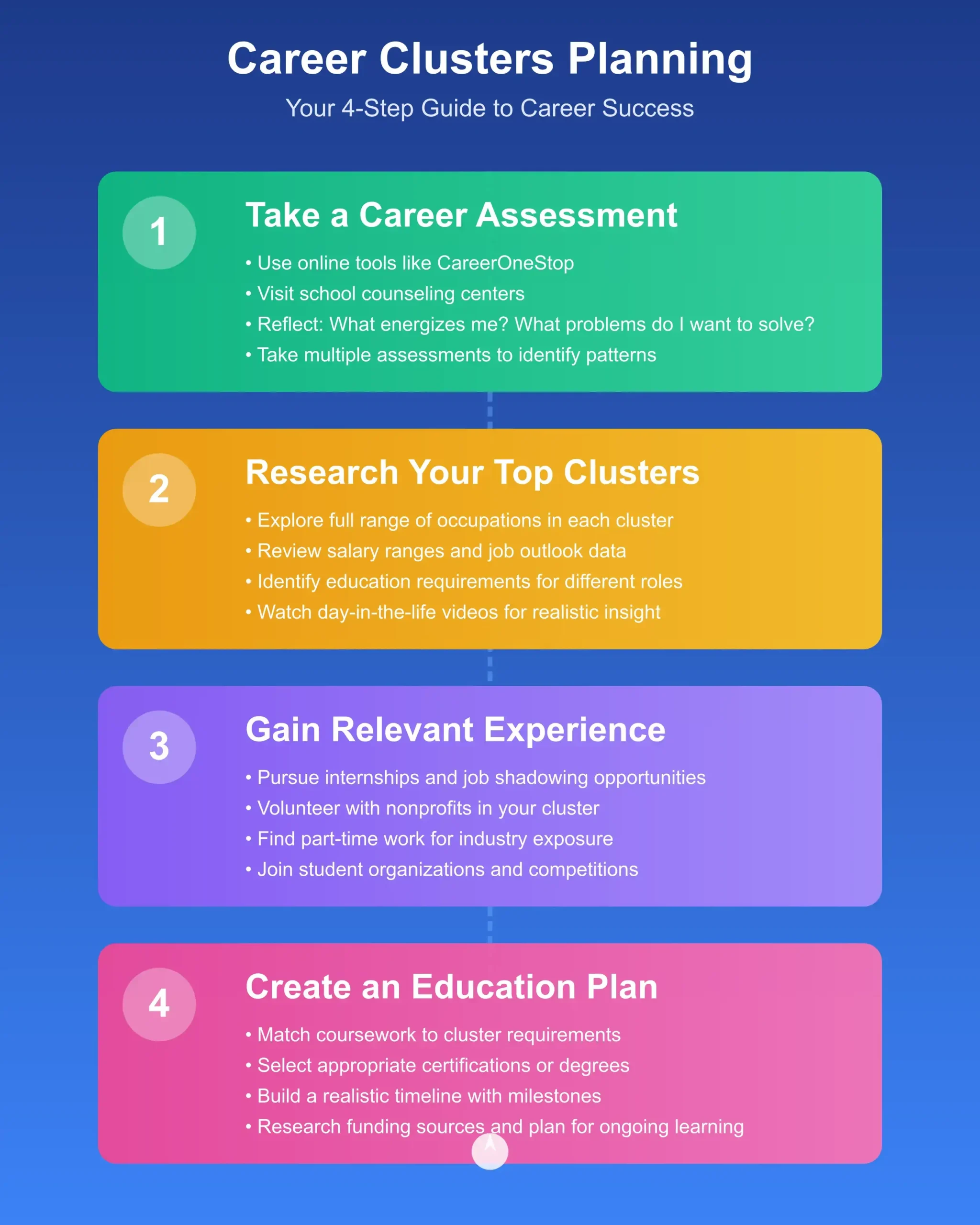
Let’s just understand how career clusters form a crucial part of the career counselling process. As a career counsellor, I conduct the following steps:
Step 1: Take a Career Cluster Assessment
Which career are you most fond of? Let’s start from there and go into detail, looking for the career options based on that interest. Take a Psychometry test to analyse your aptitude. Talk to a career counsellor. I AM AVAILABLE HERE.
Simply asking yourself the relevant questions can help a lot. Questions like:
- Am I interested in cooking?
- Do I like to code?
- Am I comfortable with the medical field?
- What work excites me the most?
Step 2: Research Your Top Clusters
After you have answered the above questions, check which career aligns with your interests. Now, ask these questions:
- What education and degree are required to become a master in it?
- What jobs are available, and what are the salaries in India or other nations?
- Is it a long-term suitable career option?
Step 3: Gain Relevant Experience
Now that you have chosen a career, you HAVE TO GROW. Gain experience. Work in various and different environments to know the industry and the profile. Skilling up will always be a part of your professional growth. There is NO ESCAPE.
At some point, if you feel “THIS IS NOT FOR ME”, then the CAREER SWITCH mode activates, and you come to the starting point of another career path. I can help you there as well in Career Change Counselling.
Step 4: Create an Education Plan
As it happens in India, you complete your 10th standard. If you go for engineering, you can choose an Engineering Diploma and then the degree. If you go for 12th, you can either choose Science or Commerce. Even after 12th Science, you can navigate towards Commerce, but not the other way around.
You have to have a plan. If you choose science, don’t drop any subjects. You might be fond of Medical now, but till 12th completion, your interest in life science may fade away, and technology might attract you more.
So, a plan related to degree, PG and skill development must be on paper in front of you. If it is worth going ahead, do it or make a few tweaks with proper career counselling.
To wrap up the clusters
Anyone navigating the complicated workplace of today must comprehend the significance of career clusters. job clusters offer the framework and understanding required to proceed with assurance, whether you’re a professional contemplating a change in job, a parent advising your child, or a student selecting a stream.
They arrange possibilities rather than restricting options.
And in a quickly shifting work market, that structure can make all the difference.