
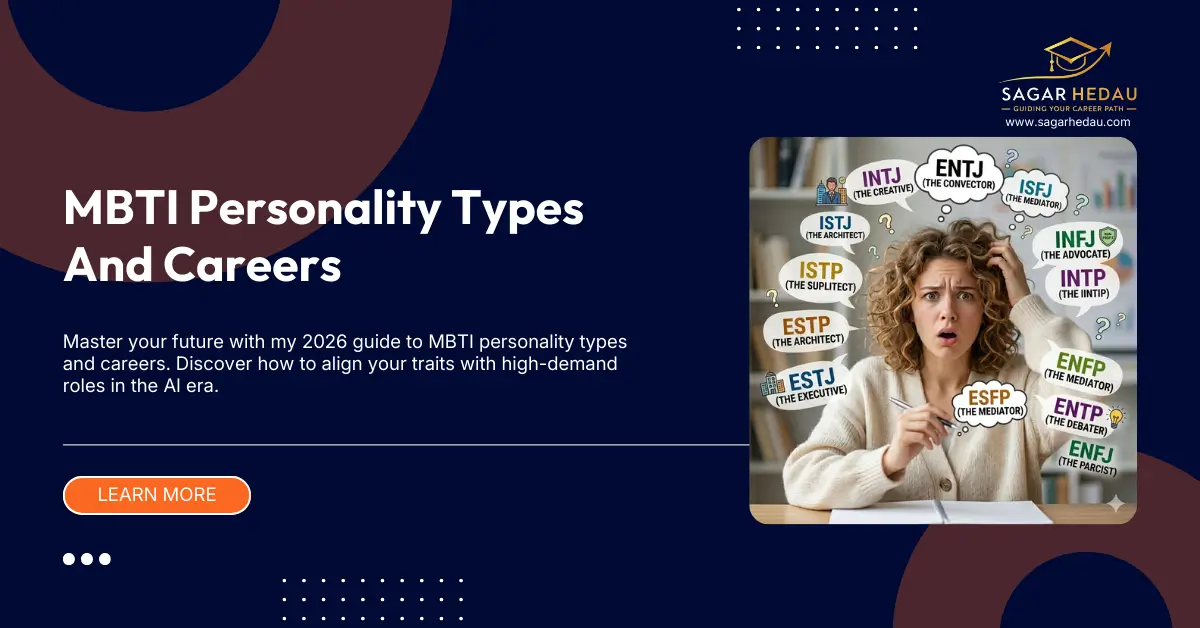
Choosing a career in India has never felt more overwhelming than it does right now. Between parental expectations, peer pressure, and an economy being reshaped by AI, most students and young professionals feel like they are picking career paths in the dark.
A striking 57% of Indian students are uncertain about their career direction, while 80% of professionals admit they feel unprepared for the demands of the 2026 job market.
This is not a confidence problem. It is an information problem.
The deeper issue is that most career decisions in India are still driven by perceived prestige rather than personal fit. Engineering because relatives approve. Medicine because the marks were good. MBA because everyone else enrolled.
This pattern has directly contributed to a 60% global burnout rate among working professionals, many of whom chose their careers for all the wrong reasons. That’s why analysing MBTI personality types and careers is very important.
The 2026 job market demands something different. With AI automating routine and even semi-complex tasks, the new competitive edge belongs to people who understand how they think, how they work, and what environments bring out their best. Static skill lists are becoming obsolete. Personality alignment is becoming the new career currency.
That is where the MBTI framework comes in. It will not hand you a readymade answer, but it will shine a clear light on who you are, so your career decisions stop being guesses and start being choices.
If you are still exploring broader directions, the guide on how to find your career path is a good place to start before diving into the specifics of personality-based guidance.
What is MBTI? The 4 Core Dimensions Explained
The Myers-Briggs Type Indicator (MBTI) was developed by Isabel Briggs Myers and her mother Katharine Cook Briggs, building on the personality theories of Swiss psychologist Carl Jung. The goal was simple: translate complex psychological theory into something practical that everyday people could use to understand themselves better.
The framework sorts people across four bipolar dimensions. Your combination of preferences across these four dimensions gives you one of 16 distinct personality types.
The 4 MBTI Personality Types
Extraversion (E) vs. Introversion (I): Where do you direct your mental energy? Extraverts recharge through social interaction and external stimulation. Introverts restore energy through solitude, reflection, and focused inner work.
Sensing (S) vs. Intuition (N): How do you take in information? Sensing types trust concrete facts, details, and present-moment reality. Intuitive types gravitate toward patterns, future possibilities, and abstract thinking.
Thinking (T) vs. Feeling (F): How do you make decisions? Thinking types prioritise logic, objectivity, and analytical consistency. Feeling types weigh personal values, relationships, and the impact on people.
Judging (J) vs. Perceiving (P): How do you approach structure? Judging types prefer planned, organised, and decided environments. Perceiving types thrive in flexible, spontaneous, and open-ended situations.
Your four-letter type, for example, ENFJ or ISTP, is simply your combination of one preference from each dimension. It describes your natural tendencies, not your limits. You can absolutely develop skills outside your type. But working within your natural preferences tends to feel less draining, more sustainable, and more fulfilling over a long career.
Understanding this distinction also ties closely to skill development, because knowing your type helps you identify which skills are likely to come naturally and which will require deliberate practice.
How Psychometry Transforms the Counselling Experience?
By using data-driven psychometric assessments, I move beyond “gut-feeling” advice and provide a concrete foundation for career decisions. Here is how this scientific approach enhances the counselling process:
- Eliminating Choice Paralysis: Many students are overwhelmed by the sheer number of career paths in 2026. A psychometric profile acts as a filter, narrowing down hundreds of options to the top 3–5 high-growth careers where the individual’s natural aptitude meets market demand.
- Objectivity Over Bias: Assessments remove the “influence of the crowd.” Instead of choosing a path based on peer pressure or outdated trends, we look at objective scores in areas like Numerical Ability, Spatial Reasoning, and Verbal Fluency.
- Predicting Long-Term Job Satisfaction: By mapping personality traits such as Introversion vs. Extroversion or Openness to Experience to specific work environments, we can predict which careers will lead to long-term fulfillment rather than just short-term employment.
- Identifying “Hidden” Skills: My assessment often uncovers latent strengths that a student may not have recognized. For example, a student struggling in traditional math may show an elite-level score in Abstract Reasoning, signaling a high potential for UX Design or AI Ethics roles.
The Assessment-to-Action Workflow
Step The Psychometric Factor The Counselling Outcome 1. Discovery Aptitude Testing Identifies what the student is naturally good at (Mental Horsepower). 2. Alignment Interest Inventory Maps those strengths to industries the student is actually excited about. 3. Strategy Personality Profiling Determines the work culture where the student will thrive (e.g., Solo vs. Team). 4. Roadmap Skills Gap Analysis A 2026-ready plan to acquire the specific certifications needed for the chosen path.
In my 13 years of practice, I’ve found that a student who chooses a career based on data is 70% more likely to stick with their degree and excel in their first job compared to those who choose based on trends alone.
The 16 MBTI Personality Types and Careers: A Summary Table for 2026
The table below maps all 16 types to their core traits, career strengths, and the most relevant career directions for India’s 2026 job market. Each type name links to a dedicated deep-dive profile where you can explore role-specific strategies, salary benchmarks, and study paths.
| Type | Nickname | Core Traits | Top 2026 Careers (India) | Famous Example |
|---|---|---|---|---|
| INTJ | The Architect | Strategic, analytical, independent, long-term thinker | Data Science, UPSC, Strategy Consulting, Research | Elon Musk |
| INTP | The Logician | Curious, logical, theoretical, precise | Software Engineering, Academic Research, Cybersecurity, AI/ML | Albert Einstein |
| ENTJ | The Commander | Bold, decisive, natural leader, efficiency-driven | Entrepreneurship, Management Consulting, Corporate Law, Finance | Indra Nooyi |
| ENTP | The Debater | Inventive, quick-thinking, loves debate and new ideas | Startups, Product Management, Marketing Strategy, Venture Capital | Steve Jobs |
| INFJ | The Advocate | Idealistic, empathetic, deep thinker, mission-driven | Psychology, Social Work, Writing, HR, Education | Nelson Mandela |
| INFP | The Mediator | Creative, empathetic, values-driven, introspective | Creative Writing, UX Design, Counselling, Education, Non-profit | J. R. R. Tolkien |
| ENFJ | The Protagonist | Charismatic, inspiring, empathetic, people-focused | Teaching, Corporate Training, HR Leadership, Public Health | Oprah Winfrey |
| ENFP | The Campaigner | Enthusiastic, creative, social, sees potential everywhere | Marketing, Journalism, Event Management, EdTech, Coaching | Robin Williams |
| ISTJ | The Logistician | Dependable, thorough, reserved, fact-based | Banking, Chartered Accountancy, Government Services, Compliance | Warren Buffett |
| ISFJ | The Defender | Caring, detail-oriented, loyal, service-oriented | Nursing, Physiotherapy, Social Services, Administration | Hema Malini |
| ESTJ | The Executive | Organised, leadership-oriented, traditional, results-focused | Operations Management, Military/Defence, Civil Services, Logistics | Dr. A. P. J. Abdul Kalam |
| ESFJ | The Consul | Warm, sociable, dutiful, harmony-seeking | Healthcare Administration, Event Management, Hospitality, HR | Jennifer Aniston |
| ISTP | The Virtuoso | Hands-on, analytical, practical, independent | Mechanical Engineering, Aviation, Forensics, Field Research | Amelia Earhart |
| ISFP | The Adventurer | Artistic, gentle, flexible, present-focused | Graphic Design, Culinary Arts, Fashion, Interior Design, Photography | Rihanna |
| ESTP | The Entrepreneur | Bold, observant, direct, action-oriented | Sales, Real Estate, Sports Management, Emergency Medicine | Donald Trump |
| ESFP | The Entertainer | Spontaneous, energetic, playful, people-loving | Media, Performing Arts, Tourism, Hotel Management, PR | Will Smith |
Important note: These career suggestions are starting points, not prescriptions. MBTI shows preferences, not destiny. A realistic career plan also requires understanding your aptitude, the effort you are willing to put in, and the realities of the Indian job market.
If you are figuring out which broad direction suits you, the article on why career clusters matter offers a helpful complementary framework for grouping career options into meaningful categories before narrowing down.
MBTI vs Psychometrics: Understanding the Difference
| MBTI Preferences (Top-of-Funnel) | Psychometric Aptitude |
|---|---|
| Relatable vocabulary for students/parents | Scientifically validated & standardised testing |
| Initial self-awareness & directional leans | Multi-dimensional diagnostic profiling |
| “What I prefer” | “What I am capable of” (Aptitude/Ability) |
This is one of the most important distinctions in career counselling, and it is one that most online guides completely ignore.
MBTI measures preferences, which are what you naturally like doing. A full psychometric assessment measures aptitude, which is what you are currently able to do well. These are very different things, and confusing them leads to poor career decisions.
Consider a concrete example. A student with an INTJ personality type shows a clear preference for analytical and strategic thinking, which makes Data Science seem like an obvious fit. But if that student has below-average numerical reasoning or struggles with mathematical abstraction, the day-to-day realities of a senior Data Science role could become a source of constant frustration rather than fulfilment.
This is exactly why a proper psychometric test for career counselling goes beyond MBTI. A comprehensive assessment includes verbal reasoning, numerical ability, spatial reasoning, and abstract thinking alongside personality profiling.
There is also a growing 2026 trend worth knowing. Career counsellors and HR professionals are increasingly combining multiple frameworks for a fuller picture.
- MBTI + Big Five (OCEAN) for predicting workplace behaviour and team dynamics with stronger scientific validity
- MBTI + Enneagram for understanding core motivations and personal growth directions
- All three + aptitude testing for the most personalised career roadmap
The bottom line: MBTI is a powerful compass. But a compass without a map only tells you which direction you are facing, not how to get somewhere specific. That is where career counselling for students bridges the gap between self-knowledge and a concrete action plan.
Why Global MBTI Advice Often Fails Indian Students?
Most popular MBTI career guides online are written for Western, particularly American, job markets. When Indian students try to apply this advice, it often falls flat because the context is completely different.
The IIT and UPSC Pressure
Standard global guides do not account for the Science stream pressure that most Indian students face after Class 10. The assumption that a student with an INTJ or INTP preference is best suited for Data Science or Engineering does not factor in the multi-year JEE preparation grind, the cost of coaching, or the realistic probability of IIT admission.
Similarly, UPSC is recommended for analytical introverts across many MBTI guides, but the seven-plus-year average journey, the emotional toll, and the limited selection rate make it a decision that needs to be evaluated far more carefully than a type match alone suggests. You can explore the full picture of these high-stakes exams in the guide to the toughest exams in India.
Stream Selection After Class 10
The decision of which stream to pick after 10th is arguably the most consequential early career fork in the Indian education system. MBTI can genuinely help here.
Students with dominant Sensing and Thinking (ST) preferences tend to be wired for the systematic, rigorous demands of the PCM stream.
Students with dominant Intuition and Feeling (NF) preferences often thrive in the conceptual creativity and human-centred thinking that Humanities and Social Sciences demand.
NT types often find the Commerce stream’s mix of analytical structure and strategic thinking deeply engaging.
Of course, these are tendencies, not guarantees. Many students with NF personalities excel in Science when they are passionate about it.
But if you are feeling genuinely torn, your personality preferences are a useful data point alongside your marks and interests. The guide on what to do after 10th if you do not want Science or Commerce is worth reading alongside your type profile.
How to Have the Conversation with Your Parents
One of the most underrated uses of MBTI data in Indian families is how it changes the conversation between students and parents. When a child says, “I do not want to do engineering,” it can feel like defiance.
When a structured personality report says “this individual has a dominant NF preference and shows strong aptitude for creative and people-centric work,” the same information suddenly sounds objective and credible.
Personality data depersonalises the conflict. It moves the conversation from “you are being difficult” to “let us talk about what environments you actually thrive in.” That shift alone is worth the investment in a proper assessment.
This connects deeply to what having a career plan actually means: it is not just a list of backup options, it is a structured case for your own future that others can understand and support.
How MBTI Helps with Career Changes Too?
MBTI is not only for students at the starting line. An increasing number of Indian professionals in their late 20s and 30s are realising that the career they chose at 17, based on marks and pressure, is no longer sustainable.
If you are feeling stuck, restless, or burned out in your current role, your MBTI type can reveal a great deal about why. People who score high on Feeling (F) preferences often feel drained in highly competitive, cutthroat environments, even if they are technically competent.
People with strong Perceiving (P) preferences frequently chafe under rigid corporate hierarchies and flourish in more autonomous, entrepreneurial settings.
The guide on career change advice for professionals walks through the practical steps involved in making a mid-career pivot, and it pairs well with a fresh personality assessment to confirm whether your new direction is genuinely a better fit or just a change of scenery.
It is also worth remembering that the 2026 job market offers more optionality than ever. Many roles AI simply cannot replace are deeply personality-dependent: counselling, leadership, creative direction, relationship management, and caregiving. These are areas where understanding your type gives you a genuine and lasting advantage.
The Honest Limitations of MBTI
No guide on MBTI would be complete without acknowledging what it cannot do.
MBTI is not a scientifically validated predictor of job performance. It does not measure intelligence, emotional maturity, resilience, or work ethic. Two people with identical types can have dramatically different career outcomes depending on their environment, support systems, effort, and opportunity.
The official Myers-Briggs Foundation itself cautions against using MBTI as a hiring tool or to box people into narrow career lanes. It is a framework for self-reflection and improved self-awareness, not a deterministic career algorithm.
Used well, MBTI is one of the most valuable tools in your career planning toolkit. Used poorly, it becomes another label that limits rather than liberates. The goal is always to use it alongside other data: aptitude results, honest self-reflection, mentorship, and informed counselling.
If you are also thinking about whether a degree or a more direct path is right for you, the degree vs. diploma comparison for 2026 is a practical read that many students find genuinely clarifying at this stage.
Your Next Step: From Direction to Clarity
The MBTI Personality Types and Careers assessment can point you in a direction. But a truly personalised career roadmap requires more than a four-letter type.
It requires understanding your aptitude scores, your values, the current and future state of the job market, and the specific pathways available to you from where you are right now in India’s education system.
Knowing you are an INTJ is the beginning of the conversation, not the end of it.
Ready to Go Beyond Your Type?
A personalised psychometric analysis maps your personality, aptitude, and interests to real career pathways in India’s 2026 job market.
Get expert guidance that combines MBTI insights with full psychometric data so you can stop guessing and start planning with confidence. Book a Career Counselling Session
Frequently Asked Questions
How does MBTI help with stream selection after 10th?
MBTI gives you a clearer picture of how you naturally process information and make decisions. Students with strong Sensing-Thinking (ST) preferences often find the structured rigour of PCM (Physics, Chemistry, Maths) more sustainable, while Intuitive-Feeling (NF) students frequently thrive in the conceptual and human-focused world of Humanities. That said, MBTI is one input among several. Your interest levels, past academic performance, and future goals all matter equally. Combining your type profile with a proper psychometric test gives you a much more reliable foundation for this decision than marks alone.
Can MBTI guide a career switch in India?
Yes, and it is one of the most underused applications of the framework. If you are feeling chronically drained, misaligned, or unfulfilled in your current role, your MBTI type can reveal why certain work environments feel unsustainable. For example, a high-Feeling type working in an aggressive sales culture may be technically competent but emotionally exhausted. Understanding this is the first step toward a more aligned pivot. The full guide on career change advice for professionals covers the practical steps involved.
What is the difference between MBTI and a full psychometric test?
MBTI measures preference: what you naturally enjoy and gravitate toward. A full psychometric assessment additionally measures aptitude: your actual reasoning abilities across verbal, numerical, spatial, and abstract dimensions. A student might have an INTP preference for analytical work, but without strong numerical aptitude, they may find advanced data science or actuarial roles genuinely difficult. The most accurate career guidance comes from combining both. You can learn more about how psychometric testing works in practice on the psychometric test for career counselling page.
Which MBTI types are best suited for engineering in India?
Types like INTJ, INTP, ISTJ, and ISTP naturally align with logical systems and technical problem-solving. However, aptitude needs independent verification; a personality inclination doesn’t guarantee numerical reasoning scores.
What is the difference between MBTI, a psychometric test, and DMIT?
MBTI measures preferences; psychometric tests measure aptitude, interest, and personality. DMIT is based on fingerprint analysis. MBTI and psychometric tests have the strongest research backing for career guidance, whereas DMIT lacks the same scientific validation.
