
Skill development is the process of developing practical skills that enhance employability, career advancement, and long-term professional stability. In today’s quickly changing market, standard degrees are no longer sufficient. Employers are increasingly prioritising the importance of skill development in candidate screening and what candidates can do rather than what they know.
- According to the India Skills Report 2026, national employability increased to 56.35% in 2026 from 54.81% in 2025, indicating a progressive transition towards a skill-first economy.
- According to the same survey, over 90% of employees currently use generative AI tools at work, highlighting the relevance of digital and IT skills.
- India now accounts for 16% of the global AI talent pool, with a predicted 1.25 million professionals by 2027.
Table of Contents
- Common Types of Skills
- What is the importance of skill development?
- Skill Development for Students
- Key Indian Statistics on the Skills Scenario
- Importance of Skill Development for Career Growth
- Importance of Skill Development in the Age of Technology
- Top In-Demand Skills in Today’s World (2026)
- Benefits of Skill Development
- How to Develop Skills Effectively?
- Challenges That You Will Face in Skill Development
- Conclusion
- FAQs
What is Skill Development?
Skill development is the process of recognising, gaining, and upgrading capabilities that enable effective performance in both personal and professional settings. Unlike traditional education, which is frequently theoretical, skill development focuses on practical competencies.
Common Types of Skills
- Technical skills: Job-specific abilities such as programming, accounting, data analysis, or machine operation
- Soft skills: Communication, leadership, teamwork, emotional intelligence
- Digital skills: Technology literacy, use of digital tools, data handling
- Life skills: Critical thinking, adaptability, decision-making, problem-solving
A balanced combination of these skills ensures workplace readiness and long-term career success.
What is the importance of skill development?
Skills enhance employability
Employability grows as people learn useful, in-demand skills. Employers are increasingly looking for applicants who can contribute immediately on the job.
The increase in India’s employability rate to 56.35% by 2026 illustrates the importance of skills over degrees in professional preparedness.
👉 India’s employability increased from 54.81% in 2025 to 56.35% in 2026, owing to digital upskilling and artificial intelligence adoption.
Promotes career growth
Professionals who reskill or upskill are more likely to advance or move into leadership positions. They stay abreast of changing job needs and remain appealing to companies.
Increases income potential
Skilled workers earn better wages and incentives than their peers who have outdated or restricted abilities. Technical and digital skills, notably in AI, data analytics, and cloud computing, are associated with a greater income growth.
Improves adaptability to change.
Artificial intelligence, automation, and digital platforms are transforming industries around the world. Those with flexible skills can negotiate change, lowering the likelihood of job displacement.
👉 Over 90% of employees are already using generative AI tools in the workplace, making digital and analytical skills essential for modern careers.
Skill Development for Students
Only academic knowledge cannot prepare students for real-world challenges. Skill development with a proper career roadmap helps students by:
- Bridging the gap between education and industry requirements
- Improving confidence, creativity, and problem-solving abilities
- Enhancing internship and placement opportunities
- Encouraging independent thinking and lifelong learning
Students who develop communication, technical, and analytical skills early are better prepared for employment, higher education, and entrepreneurship.
Employer Demand for Key Skills
| Skill Type | Importance Rating | Growth in Next 5 Years) |
|---|---|---|
| Communication (Verbal/Interpersonal) | 98% | +57% |
| Collaboration & Teamwork | 92% | High |
| Critical Thinking / Analytical | 87% | High |
| Technical Skills (Programming/Data) | 65.7% | Moderate |
Long-Term Financial Impact
- Early mastery of analytical and reading skills is directly associated with better adult wages.
- According to the University of Edinburgh and BBC News, mastering these skills as early as age 7 or 10 results in significant salary increases by age 42.
- Math proficiency at age 10 results in 7% higher incomes by age 30 than colleagues with ordinary skills.
- Reading level rise at age 7 leads to an average annual income increase of £5,000 (~$6,300) in mid-adulthood.
- General Skill Levels: High-skilled workers (Level 4) earn 2.2 to 2.4 times more per year than low-skilled workers.
Key Indian Statistics on the Skills Scenario
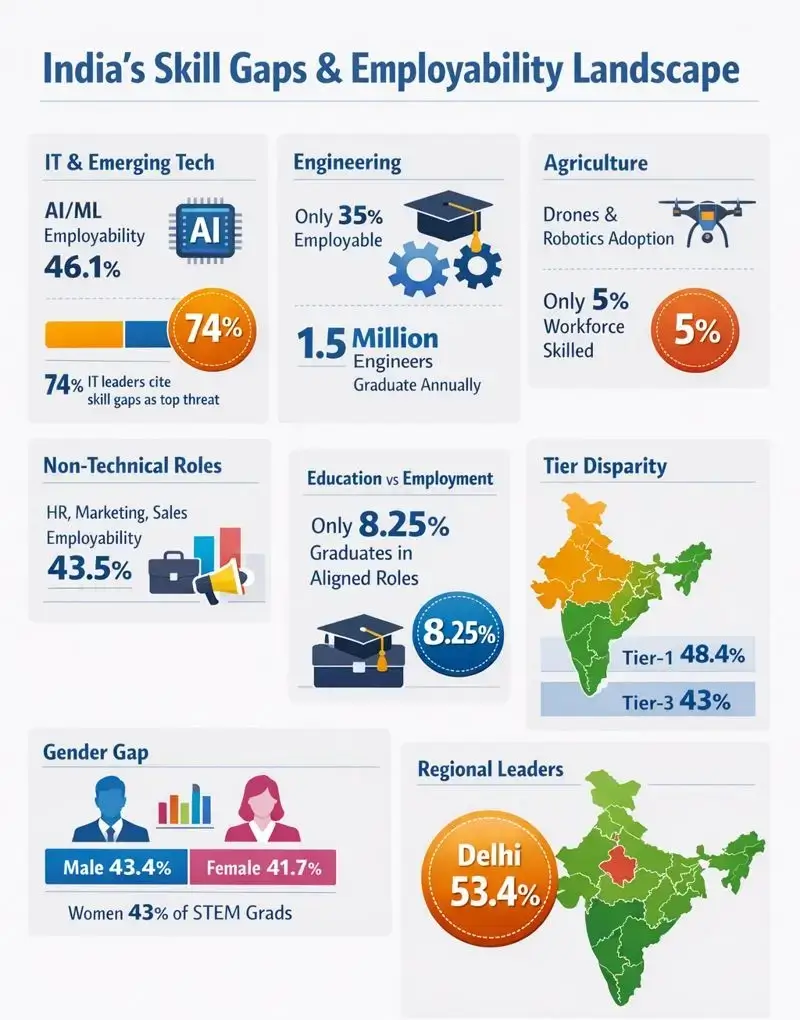
| Statistic / Indicator | Indian Data & Insight |
|---|---|
| National student & graduate employability | India’s employability rate reached 56.35% in 2026, reflecting improved skill readiness among students and young professionals. |
| Gender-wise employability | Female employability (≈54%) surpassed male employability (≈51.5%) for the first time, indicating growing participation of women in skill development programmes. |
| AI & digital skill readiness | India contributes around 16% of the global AI talent pool, expected to grow to 1.25 million skilled professionals by 2027, showing rising demand for tech skills among students. |
| Skill-based education in schools | Only 47% of Indian schools offer skill-based or vocational courses at the secondary level, highlighting limited early exposure. |
| Skill Level Mismatch | Approximately 88.2% of the Indian workforce is employed in low-competency jobs, while only 12% are in high-competency roles. |
| Student participation in skill courses | Just 29% of students opt for skill-based subjects, despite increasing industry demand for practical skills. |
| Formal Training Gap | Only 2.3% to 4.7% of the Indian employees receive formal vocational training, compared to 52% in the USA and 96% in South Korea. |
| Graduate skill gap | Over 50% of Indian graduates are employed in low-skill jobs, mainly due to inadequate practical and soft skills at the time of graduation. |
| Internship & hands-on training | Government initiatives like the Prime Minister Internship Scheme aim to provide 100,000+ internships, helping students gain real-world industry skills. |
| Apprenticeship & industry linkage | State-level apprenticeship programmes trained 80,000+ students and youth annually, strengthening job readiness before graduation. |
Skill development is critical for equipping students to work in today’s competitive job market. In India, the employability rate is projected to reach 56.35% by 2026, indicating that students with practical and industry-relevant skills have greater career prospects.
Despite this progress, early talent exposure is restricted. Only 47% of schools offer skill-based courses, and only 29% of students register in them, resulting in a mismatch between education and industrial requirements. As a result, over half of graduates work in low-skilled positions due to a lack of practical and soft skills.
At the same time, the need for advanced talents is increasing, with India accounting for approximately 16% of the global AI talent pool.
Internship and apprenticeship efforts, which teach over 80,000 students each year, serve to bridge this gap by giving hands-on experience. Overall, the statistics show that early and ongoing skill development enhances student employability and job preparedness.
Importance of Skill Development for Career Growth
For working professionals, skill development ensures sustained career growth and relevance.
Key Benefits for Professionals
- Greater job security during economic or technological shifts
- Easier career transitions into new roles or industries
- Increased professional credibility and organisational value
- Better access to leadership and managerial positions
In dynamic job markets, skill development offers long-term employability rather than short-term job stability.
Importance of Skill Development in the Age of Technology
Technology has transformed how work is performed. Artificial intelligence, automation, and digital platforms now define productivity and efficiency.
India currently holds 16% of the global AI talent pool, projected to reach 1.25 million professionals by 2027, reinforcing the importance of continuous digital upskilling.
Rather than replacing human workers entirely, technology rewards those who can work alongside it. Skills such as analytical thinking, adaptability, and digital literacy are now critical.
Top In-Demand Skills in Today’s World (2026)
The most valuable skills across industries include:
- Communication and interpersonal skills
- Analytical and critical thinking
- Digital and technology literacy
- Leadership and teamwork
- Adaptability and resilience
- Data interpretation and problem-solving
Developing both technical and soft skills ensures holistic professional growth.
Benefits of Skill Development
- Better job opportunities
- Higher earning potential
- Increased confidence and self-reliance
- Improved adaptability to change
- Long-term career stability
- Greater professional flexibility
These benefits apply at every life stage, from students to experienced professionals.
How to Develop Skills Effectively?
An effective skill development strategy must focus on:
- Identifying skill gaps based on career goals
- Choosing relevant learning platforms (courses, workshops, certifications)
- Applying skills through projects, internships, or real-world tasks
- Continuously updating skills to match industry changes
Consistency and practical application are key to sustainable skill growth.
Challenges That You Will Face in Skill Development
- Lack of awareness about in-demand skills
- Limited access to quality training
- Time constraints for learners
- Rapid shifts in required skills
Understanding these challenges is the first step in addressing them.
Conclusion
The importance of skill development lies in its ability to future-proof careers. Skills now determine employability, income potential, and professional longevity more than academic qualifications alone.
As industries evolve and technology advances, continuous skill development is the most reliable path to long-term success.
By adopting a lifelong learning mindset and actively investing in skill development, individuals can build resilient, adaptable, and rewarding careers.
FAQs
What is skill development?
Skill development is the process of learning and improving practical abilities, technical, digital, soft, and life skills that make individuals job-ready and adaptable.
Why is skill development important today?
Skill development improves employability, income potential, and adaptability, especially in technology-driven and rapidly changing job markets.
How does skill development improve employability?
Individuals with relevant skills are more job-ready and competitive, as shown by India’s employability rate increasing to 56.35% in 2026.
What skills are most important for the future?
Digital literacy, communication, analytical thinking, leadership, and adaptability are among the most in-demand skills across industries.
How can students develop skills effectively?
Students can develop skills through internships, online courses, real-world projects, and continuous practice aligned with industry needs.
